
February 2026 News
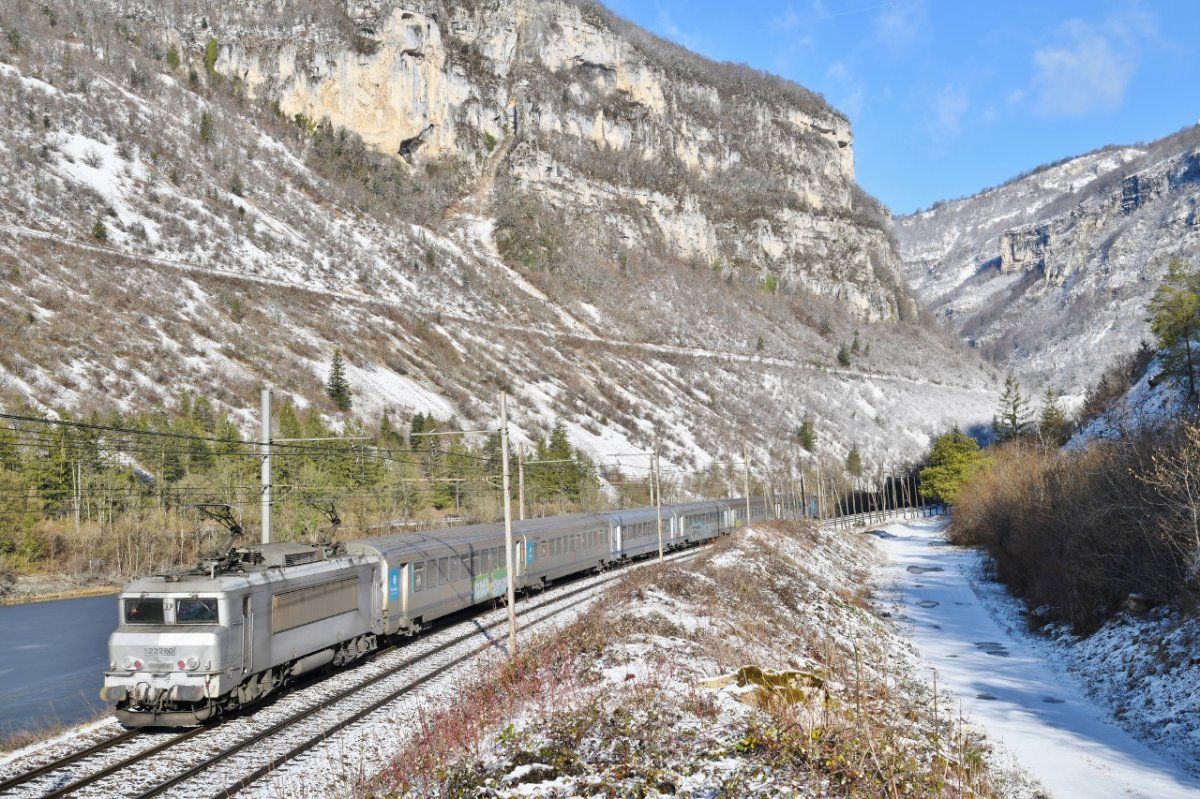
Chambéry BB 22200s in the snow
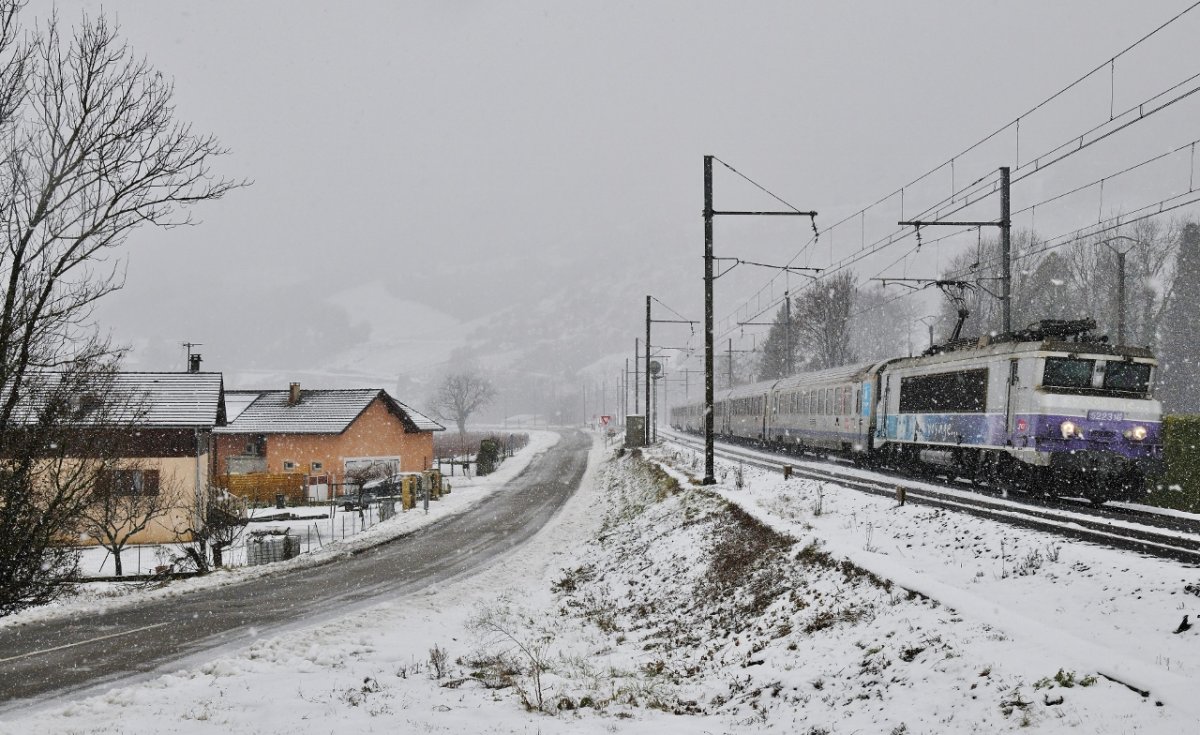
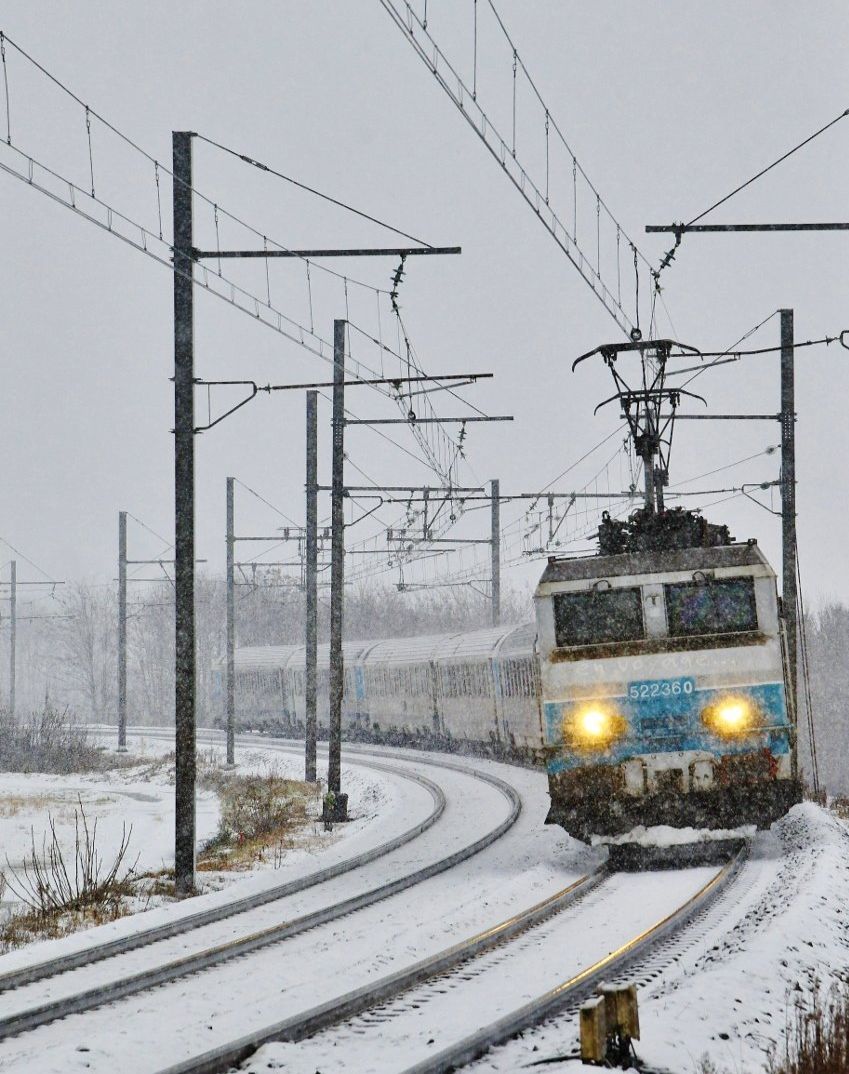
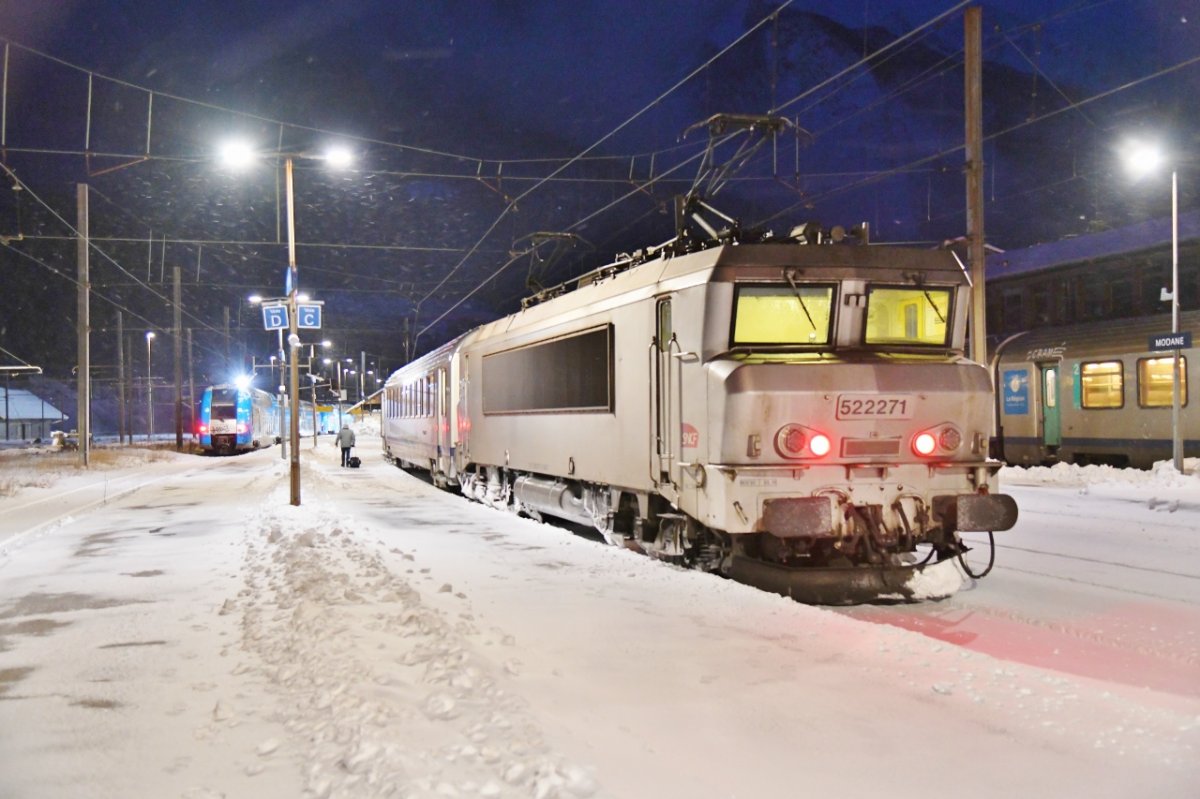
A selection of Chambéry-based BB 22200s seen on AURA TER services over the weekend of 10/11 January.
Above. BB 22260 is passing Les Hôpitaux (Ain) between Ambérieu and Culoz with TER 17976, the 10.08 Lyon Part Dieu – Annecy on 11 January.
Right. BB 22360 approches Saint-Jean-de-la-Porte with TER 883462 09.18 Modane – Lyon Part Dieu on 10 January, while coming in the other direction (below) BB 22316 powers TER 883405 the 07.24 Lyon Part Dieu – Modane.
Bottom. BB 22271 upon arrival at Modane with TER 883425, the 14.50 from Lyon Part Dieu on 10 January.
Photos: Pierre Julien.
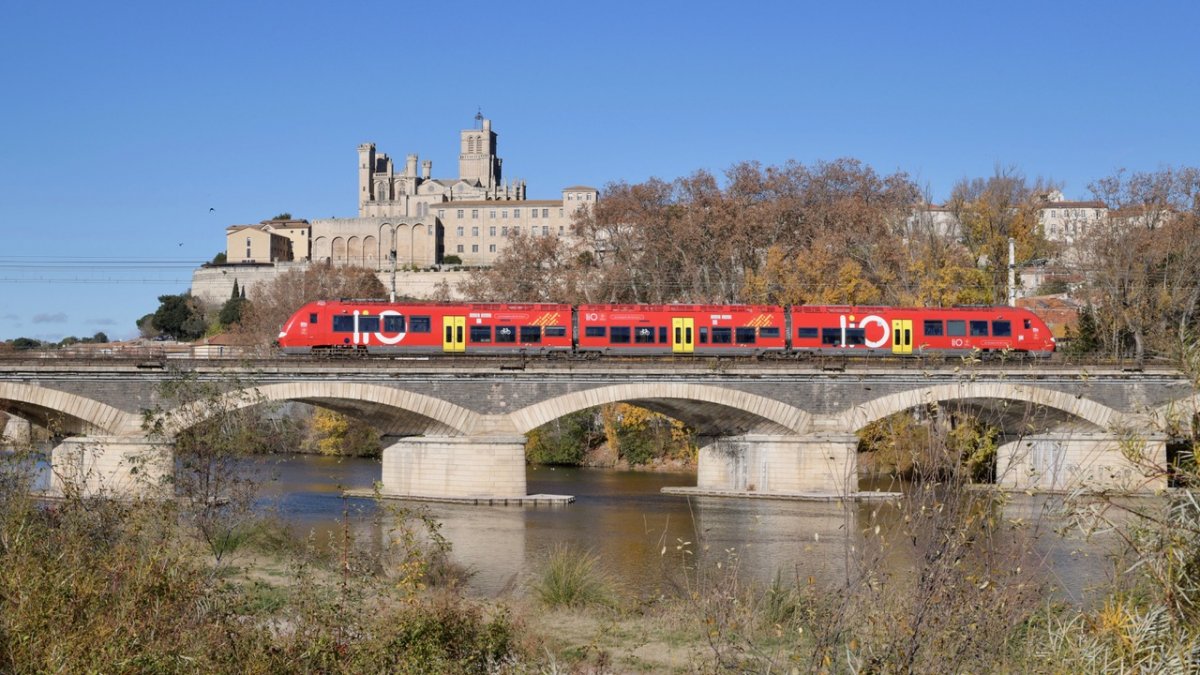
Resplendent in its striking liO livery, doyen of the class, AGC Z 27501/02 crosses the River Orb at Béziers with a service to Narbonne on 5 December 2025. Photo: Jean-Louis Poggi.
Emergency funds for Occitanie
SNCF announced a three-year €60 million emergency upgrade for Occitanie’s railways on 17 December, designed to ease the operating problems that have plagued the network in recent months, when 20% of trains were delayed or cancelled. The région’s president, Carole Delga, had asked SNCF’s new PDG Jean Castex to come up with proposals ‘within 15 days’ to ensure the ‘safety, reliability and capacity’ of Occitanie’s 2,514km network. Most of the money will be spent on repairing damaged and unstable infrastructure in the former Midi-Pyrénées, where climate events and malicious acts have hit harder than in the Languedoc-Roussillon area to the east of the région. The main elements, costed at €50 million, are:
● Upgrading of signalling to improve reliability on the Toulouse – Tarbes and Latour-de-Carol lines.
● Replacement of life-expired track components on the Auch and Montauban lines.
● New signalling cables on the Auch line.
● Acceleration of level crossing replacement, with a further 10 underway in Hautes-Pyrénées.
● Identification of obsolete infrastructure and equipment; prioritisation of works to rectify the worst cases.
A further €10 million will be spent to improve reliability: easing the most severe speed restrictions on the Toulouse – Castres/Rodez/Figeac and Latour-de-Carol lines; providing more protection from intrusion by wild animals; and strengthening infrastructure most at risk from severe climate events, including catenary on the main line from Toulouse to Narbonne. PN161 between Carmaux and Rodez, frequently the cause of delay due to malfunction, will be rehabilitated. There will also be a big push to secure installations from malicious acts by improving fencing, providing extra surveillance, and liaising more closely with local police.
A dedicated task force will be created with the aim of achieving ‘rapid and visible results’. SNCF Voyageurs said that 149 drivers had been taken on over the past two years, and a further 20 were undergoing training. Recruitment of additional technical and workshop personnel was underway. Penalties for poor performance in 2025 amounted to €4 million, money which is being reimbursed to annual passholders this month, giving them four weeks’ free travel. Travellers on the poorest-performing routes, from Toulouse to Rodez, Foix, Auch, Tarbes and Narbonne, have been receiving reimbursements for several months.
Amongst the worst affected routes is Auch – Toulouse. Despite a major rebuild in 2008-09, the line has suffered numerous defects leading to periodic closures for remedial work. November saw a complete collapse of the service; 580 trains were cancelled due to infrastructure problems, notably the 3 November points failure at L’Isle-Jourdain which necessitated manufacture of bespoke components for the ancient mechanism, and vandalism of signalling equipment at Brax. Service should have returned to normal on 5 December but further delay was caused by staff and rolling stock shortages and a level crossing malfunction. Then, when service resumed, no trains ran beyond L’Isle-Jourdain or Gimont to Auch for several weeks as the track was blocked by farmers protesting against the Mercosur trade agreement. That section eventually reopened on 9 January after the blockages had been cleared away, but only four morning trains ran that day due to ‘abnormal weather conditions’. Full service was restored on 10 January.
SNCF will begin remedial work ‘as soon as possible’ along with track upgrading already programmed for late 2026, and will review its surveillance and safety measures in the light of the very high level of vandalism. Occitanie will commit €4.5 million to the emergency work over the coming 12 months. Mme Delga is also pressing for the Auch line to be reclassified as part of the national network rather than a regional desserte fine, so that it would qualify for State grants.
Draisy for Agen – Auch
Amid the tribulations of the Auch – Toulouse line, Gers département’s only railway, SNCF PDG Jean Castex has given the green light for trials of the Draisy railcar on the Auch – Agen line, fulfilling a long-standing aim of supporters led by the association Club TGV Gare d'Agen. Gers residents are contributing to the cost of building the Bordeaux – Toulouse LGV and see reopening of the link north to Agen and the Agen-Brax TGV station as vital to the département’s future. Reopening of the line to Auch would bring the Gers prefecture (population 25,000, agglomération 84,000) within a little over 4h hours of the capital, against today’s best time of 5h 15 by bus to Agen or 6h 48 by rail via Toulouse. The restored service might also serve the towns of Layrac, Lectoure and Fleurance with a combined population of 15,000. Estimates suggest that 100,000 passengers annually from the Auch direction would use the Agen-Brax TGV station.
The line lost its passenger service in 1970 and was closed to freight after storms damaged the track in 2016. Now the least-degraded section between the junction at Bon-Encontre and Astaffort (13km) is to be cleared of vegetation for trials to take place in a joint initiative with Agen Agglomération. Draisy is scheduled to undergo dynamic trials next month at the VUZ Velim test track in Czech Republic, followed by testing on the 7km between Kalhausen and Sarralbe in Grand Est. If successful, it is hoped SNCF will authorise running trials in Gers before the end of the year.
Castex had said it was necessary for Gersois to show they really wanted the line to reopen. In response, local authorities have financed feasibility studies costing €200,000 and there is to be a six-month campaign to raise awareness amongst the general public. The 64km alignment is in poor condition and surveys show a three-year window of opportunity for restoration without the need for complete rebuilding.
Ferroutage derailed
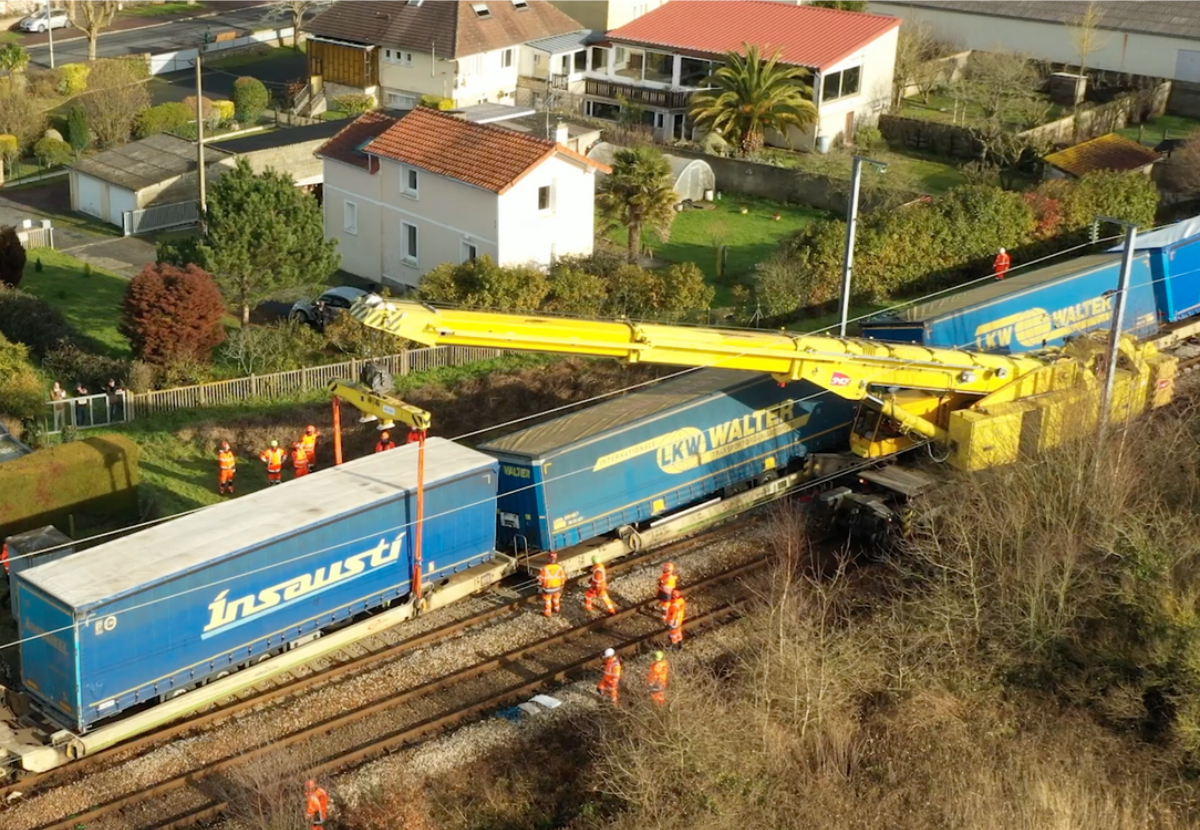
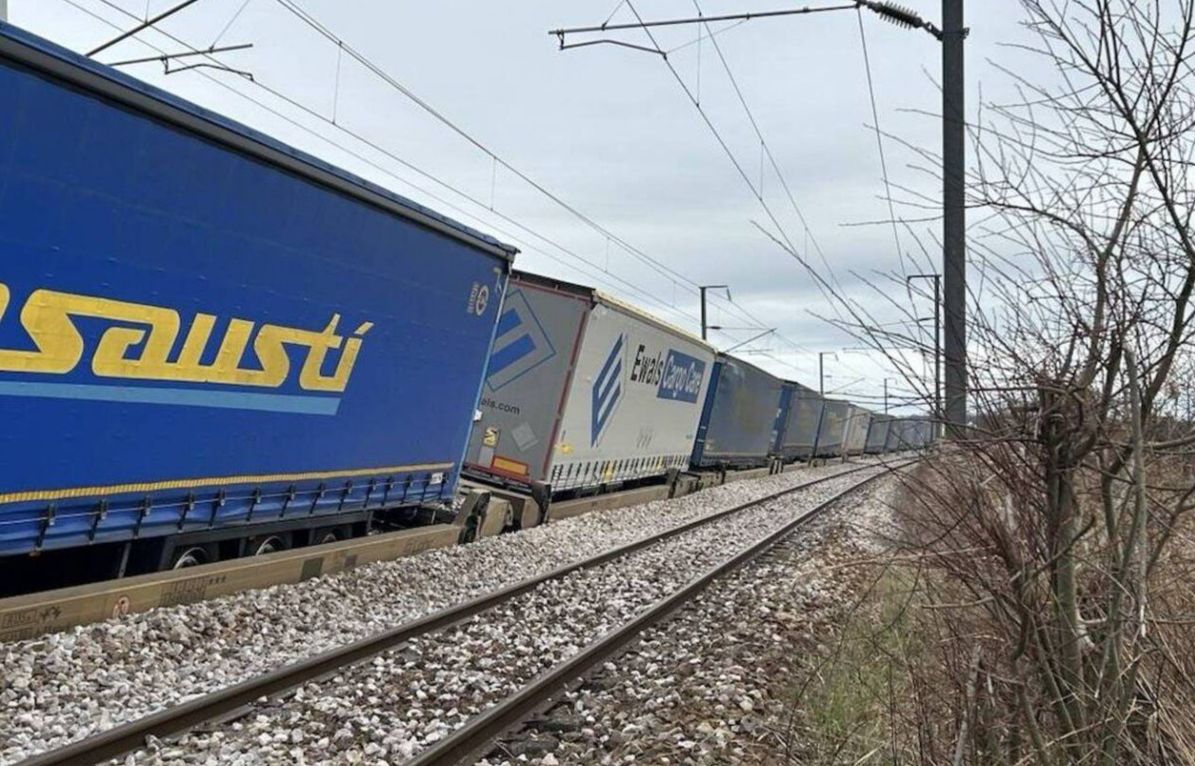
Brittany Ferries’ Cherbourg – Bayonne ferroutage train, headed by Captrain Stadler E4001-3976 and running 2h 40min late, derailed at 15.25 on 11 January at Km312 close to Carentan station in Normandie. Fifteen of the 17 Modalohr wagons left the track. SNCF’s Kirow rescue crane, capable of lifting 150tonnes, arrived at Lison from Dijon on 14 January and a second Kirow crane was hired-in from TSO to assist. Work to recover the 34 semi-trailers began two days later in an operation described by SNCF as ‘of unprecedented complexity’ on account of the low-slung articulated Modalohr flats. Two of the trailers were first lifted in a trial exercise to determine the most suitable method of working. One damaged beyond repair was cut in half in situ to facilitate removal, others were repaired and taken back to Cherbourg for inspection. Around 100 personnel were involved in the clearing-up operation.
Meanwhile, MUs stranded at Cherbourg were dragged past the blockage to Caen depot and passenger service was maintained by a fleet of buses with rail connections at Caen; Caen – Lison – Saint-Lô trains were augmented or strengthened. On the freight side, Brittany Ferries diverted a passenger vessel from other operations to run a freight-only service from Poole to Bilbao until the end of January, while Orano negotiated with SNCF a weekly path on the Down line so that spent nuclear fuel could access the processing plant at Valonges.
SNCF plan to reopen the Down line for single-track operation on 5 February with trains from Cherbourg reservation-only, and the Ferroutage service was also expected to restart. Reinstatement of the other line will take about six weeks SNCF said, with 500m of track to be replaced and 700m fettled and realigned, and 1.2km of overhead restrung. Total cost of the rescue and restoration is €10 million.
Detailed investigations were underway into the cause of the derailment but until the track had been completely cleared it was impossible to determine conclusively.
Photos: Left. Ville de Carentan. Top. SNCF Réseau.
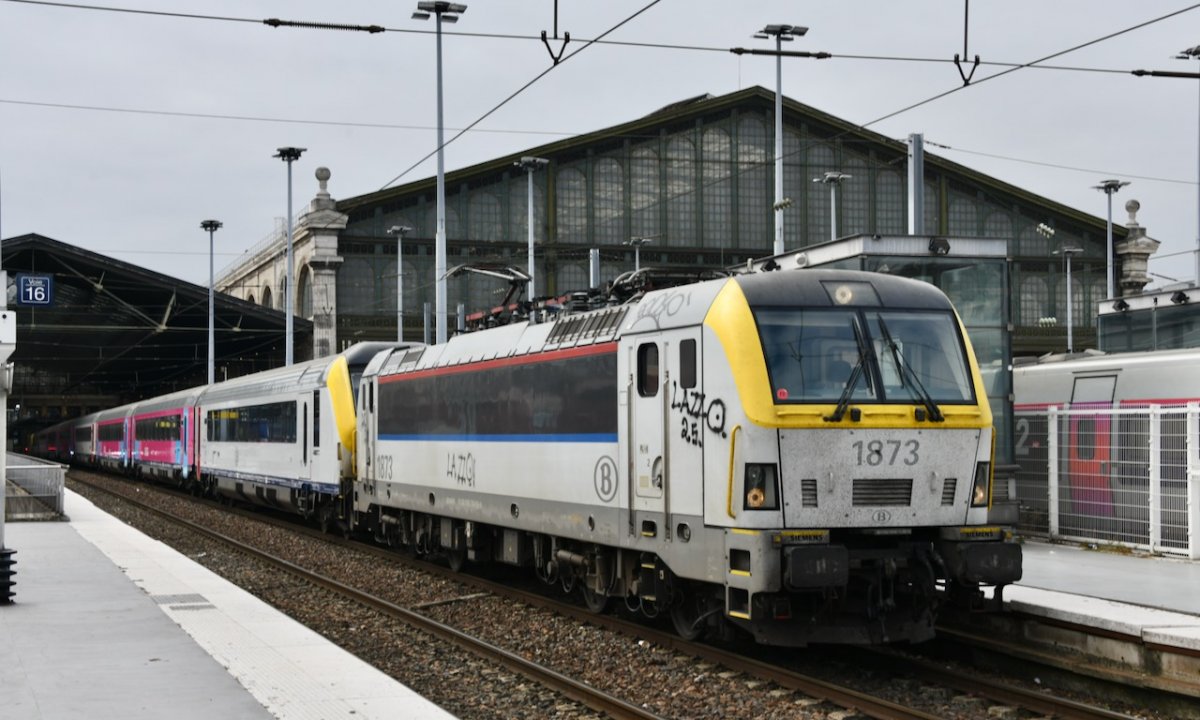
With the demise of Class BB 15000 workings, the only regular loco-hauled activity at Gare du Nord is the SNCB Class 18 Siemens Eurosprinters that haul Paris – Brussels Ouigo services. On 16 October, No 1873 waits to depart with Ouigo 65 the 12.13 Paris Nord – Brussels Midi. Although the consist includes a driving trailer for push-pull working they are not authorised for use in France. Photo Didier Delattre.
Future Gare du Nord
Plans for Future Gare du Nord, the second phase of the Paris station’s redevelopment project, were presented to the public on 8 December. Two years on from completion of the Horizon 2024 works which eased the handling of Olympic Games crowds, SNCF Gares et Connexions is embarking on further renewal and expansion of Europe’s busiest station to cope with an additional 50 million passengers annually by 2030. The works are concentrated in four main areas:
● Redevelopment of the Eurostar departure areas (Transmanche), increasing space by 60% to accommodate passengers on competing services and provide better amenities, with additional access to the mezzanine at ground-floor level; the number of check-in terminals will triple and larger waiting areas provided. The terminal will be able to handle two trains/h of the higher-capacity stock expected on future Transmanche services.
● Le Parvis SNCF, the area in front of the bus station and cycle storage facilities built in the first phase, will be replanned with new trees and greenery, commercial space revamped to increase customer choice, and climate-related works carried out.
● Construction of La Dalle 1, a building and circulating space on the east side to further open up the station, including a new staff operations centre.
● Redevelopment of office space at 110 bis rue de Maubeuge on the west side of the station where many staff are based.
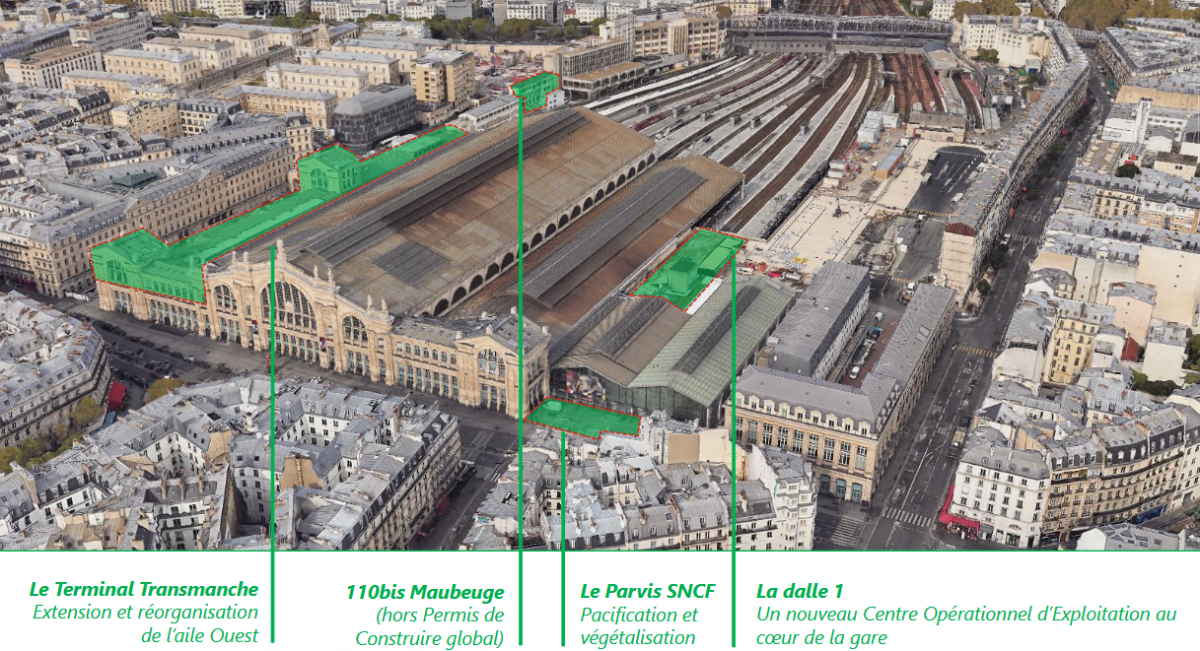
The station’s environmental footprint will be improved by an additional 490m2 of photovoltaic panels, new systems of rainwater recovery and storage, and extensive reuse of existing materials. Most of the work will be carried out during the day with minimum impact on train movements and passenger throughput, whilst also respecting the needs of businesses and residents in surrounding streets.
Preparatory work starts this year on the Transmanche and Dalle 1 projects. Le Parvis will be completed next year, and the whole scheme delivered by 2029 when the first competing Transmanche services are expected to be running.
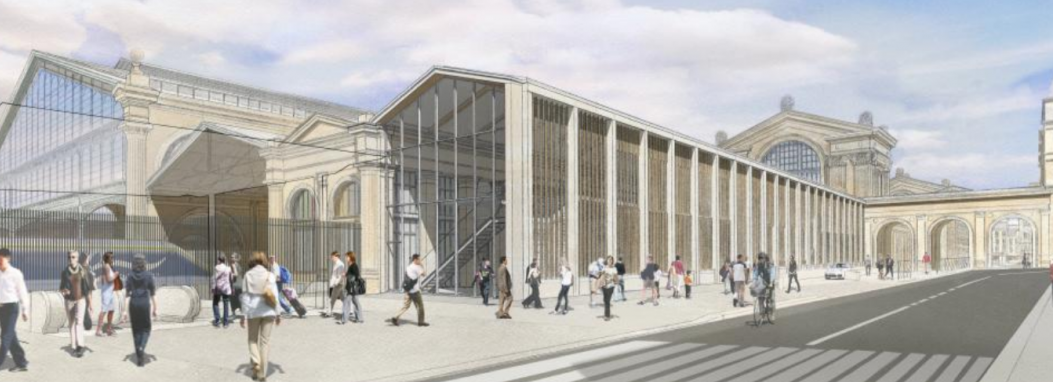
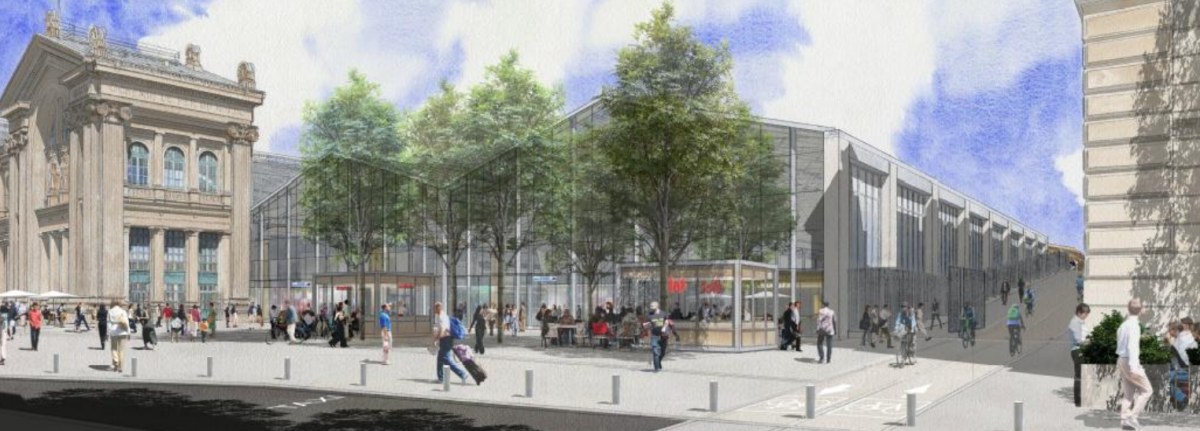
The Transmanche extension (left) preserves a view of the historic façade through its glass cladding while providing new access and increasing the international terminal circulating areas by 4,300m2. Le Parvis SNCF (right) will be a green breathing space and welcoming entrance to the east side of the station. Images: SNCF
‘Turn up and go’ for St Pancras
Coincidentally, in an interview with The Financial Times, the chief executive of London St Pancras Highspeed Robert Sinclair said the company’s planned revamp of the international facilities at St Pancras aimed for passengers to “turn up and go”. Current check-in times of up to 90min would be a thing of the past. He pointed to London City airport as a model, “where a bad outcome is 10min [waiting time]”. Repositioning the queue lines would allow passengers a faster passage through security checks; access to platforms would be opened sooner than is often the case, relieving pressure on overcrowded waiting areas. As with the Gare du Nord expansion, he hoped the international station would be transformed within four years, ready for the influx of passengers expected when new entrants bring competition for Eurostar.
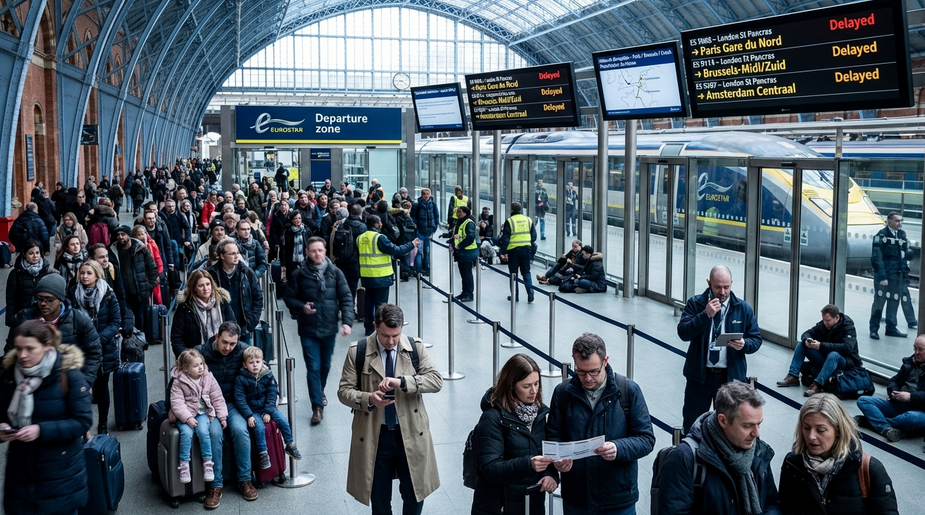
Saturday 27 December saw widespread delays to Eurostar services due to ‘operating and technical issues’, capacity problems at Gare du Nord in Paris and difficulties on both the Belgian and Dutch networks. Three days later, an electrical fault in the Channel tunnel and breakdown of a shuttle train halted all services for several hours; 30 trains were cancelled. Eurostar 9152 18.04 London – Amsterdam was stuck overnight on the 30th without heat, light or toilets, passengers eventually detraining at Lille 11h later. During the disruption, additional queueing lanes were in use on the Grand Terrace at St Pancras. Photo:The Traveler.
Air-fares blitz. The Independent reports that airlines are stepping up the number of flights between London airports and Paris Orly/CDG. By April, on Fridays there will be 27 London – Paris flights against 18 trains, with airlines targeting in particular short-notice travellers for whom late booking on Eurostar can be much more expensive than flying. Looking on 4 December for travel the following day, the paper found eight flights cheaper than Eurostar’s best price of £196 which was only available at 06.01 from London. Other rail fares were up to four times the cheapest flights. Responding to past criticism of Eurostar’s high fares, CEO Gwendoline Cazenave said that its market share on the London – Paris route was 80%, and that it is “not a low-cost company”.
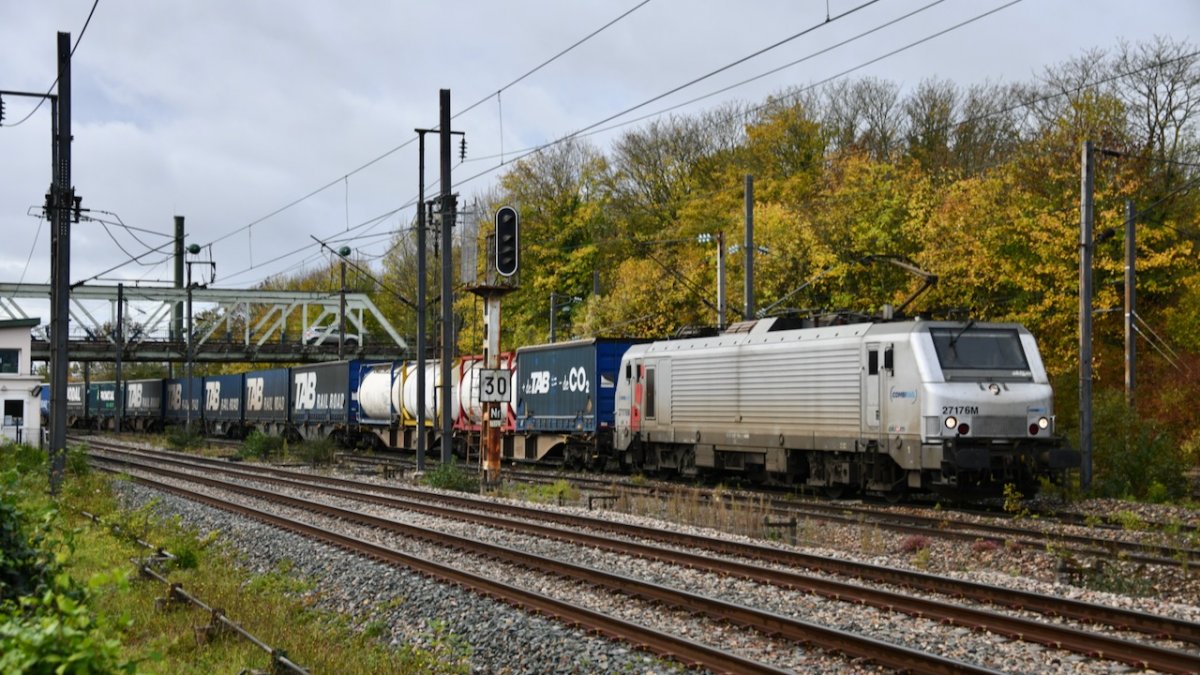
In December 2024 Combirail, one of Franc'e smaller freight operators, introduced a third daily service from Lille to Avignon and Miramas, via Valenton and Lyon. Combirail also operates daily services from Paris (Bonneuil) to Avignon and Miramas. The services are provided for combined transport operator T3M, and all are part of the Open Modal Group who operate 12 intermodal terminals across France and Italy. Above, on 28 October BB 27176, leased by Combirail from Akiem, enters Lille Deliverance with Train 50525 from Miramas.
Photo: Didier Delattre.
Medway France up and running
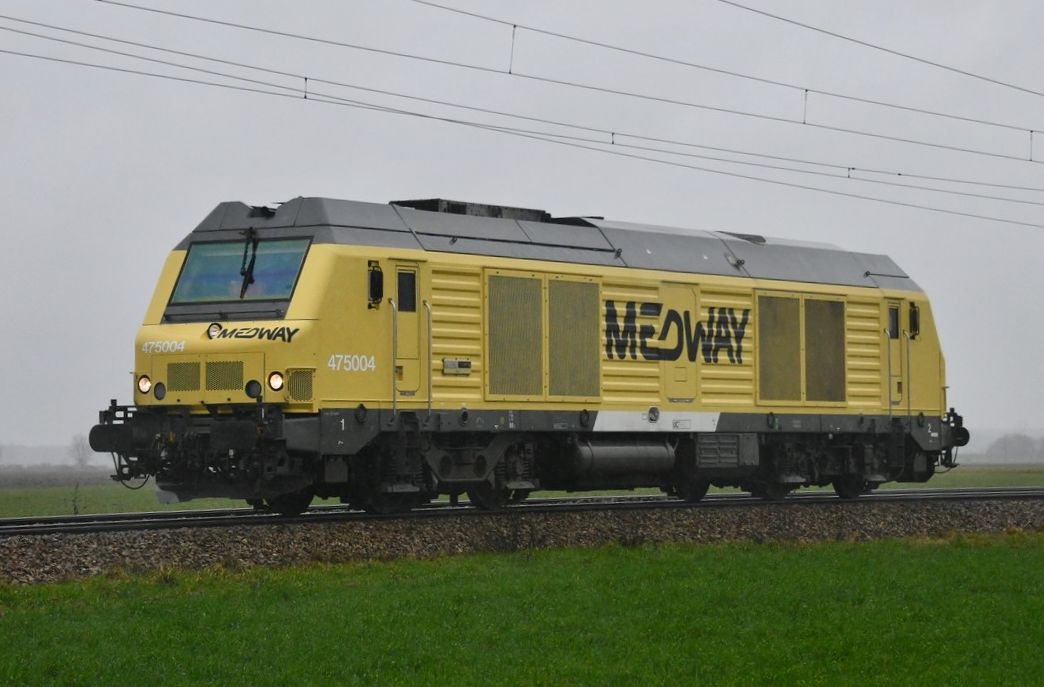
New freight operator Medway France has taken over trains from Caffiers to Grande Synthe (Dunkerque) from Hexafret. Since 14 December, two trains a day of up to 40 wagons (3,600tonnes) are run for ArcelorMittal, carrying limestone from the Carrière du Boulonnais quarry at Ferques to steelworks at Dunkerque. The morning service is formed of a half train each from Ferques and the Chaux et Dolomies du Boulonnais (Lhoist group) quarry at Rety carrying quicklime in covered hoppers. These are joined at Caffiers for the 57km run to Dunkerque. Traction is still pairs of BB 75000 diesels, required to cope with steep gradients between the quarries and Caffiers. Medway has purchased Nos 75004, 75050 and 75067 from SNCF and is turning them out in its mustard yellow livery.
Owned by logistics company MSC, Medway started by taking over Portuguese national operator CP Carga in 2016, later extending operations into Spain, Italy and Belgium. In France it has taken advantage of the break-up of Fret SNCF to establish itself, although the ArcelorMittal traffic does not seem to be a natural fit. It is likely that Medway will target maritime intermodal traffic, currently dominated by SNCF subsidiary Naviland Cargo, saying that its presence in the port of Dunkerque will open up opportunities for intermodal traffic and bulk cargo.
Opposite. First outing for newly repainted BB 75004 seen approaching Hazebrouck on 27 January, running as 357461 Lens - Dunkerque. Photo: Didier Delattre
New electric locos
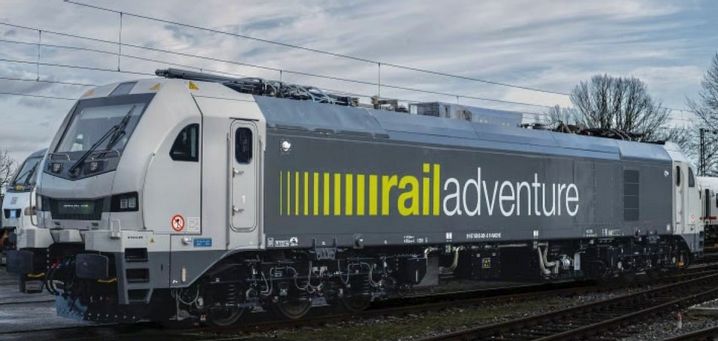
On 19 December, RailAdventure, a German operator which specialises in moving rolling stock around Europe, announced it had also acquired a Euro 6000 (short EVN 6031) for operation by RailAdventure France SAS. The loco is intended for heavy-duty use in test, acceptance and transfer running, particularly cross-border into Spain, Belgium and Luxembourg. The company had been using a Vossloh DE 18 diesel, in many cases under the wires, until recently and had hired an Akiem BB 37000 in the last few weeks of 2025. Photo: © RailAdventure.
Meanwhile at the beginning of the year the Alstom Traxx Universal MS3 was authorised to operate in France. Three locos with a last-mile diesel engine will be delivered to Railpool for leasing to RegioRail which will use them on clinker trains from Sète and Tonneins, replacing Class 66 diesels. A total of 200 Traxx Universal locos are on order for operating in France, although many will probably be used on other routes. They are: Akiem (100, of which 65 firm), Northrail (50, 15 firm) and Railpool (50). Designated Class 187 (the RegioRail are expected to be 188) the Traxx Universal has a maximum speed of 200km/h while offering last mile remote control for single-man shunting, and minimum maintenance intervals of 40,000km.
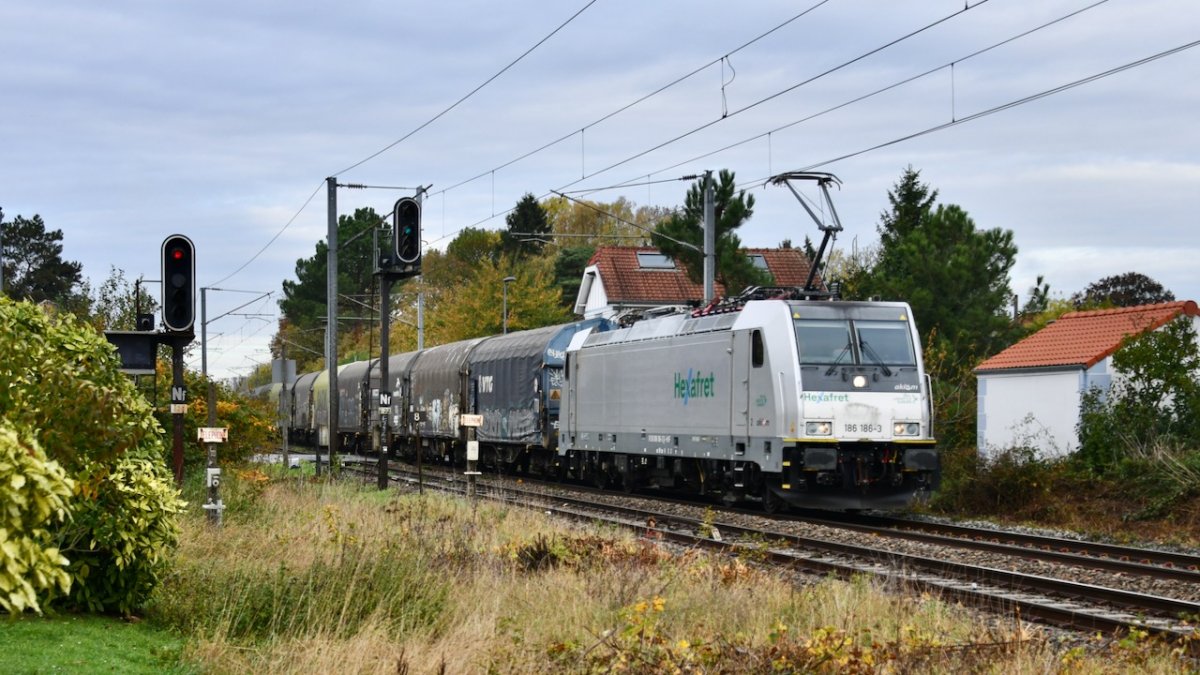
Hexafret currently has a fleet of 12 Class 186 Traxx MS2, leased from Akiem, for use on cross border traffic in northern France. On 22 October 186.186 [asses Ascq with Train 49879 Dunkirk – Liège, Note the red light signal C24, controlling a redundant former track.
Photo Didier Delattre.
On 5 November 2025 X 73662 became the fourth member of the class to be withdrawn. Part of the AURA TER fleet, it entered service in February 2002. It is believed to have sustained damage at a level crossing in 2023.
The 318-strong Class X 73500 entered service between 2001 and 2004, replacing a range of postwar autorails that often operated over rural lines with one or two trailers.
The single cars were a great advance on their predecessors, designed to bring the streamlined style and ambiance of TGVs to the local trains that connected with them. Air-conditioning, wide doors, spacious toilet and a low-floor centre-section were firsts for rural lines, plus they are fully accessible. Large windows are ideal for viewing the scenery, though the seating arrangement is somewhat cramped. The cars were designed for driver-only operation but have never run as such.
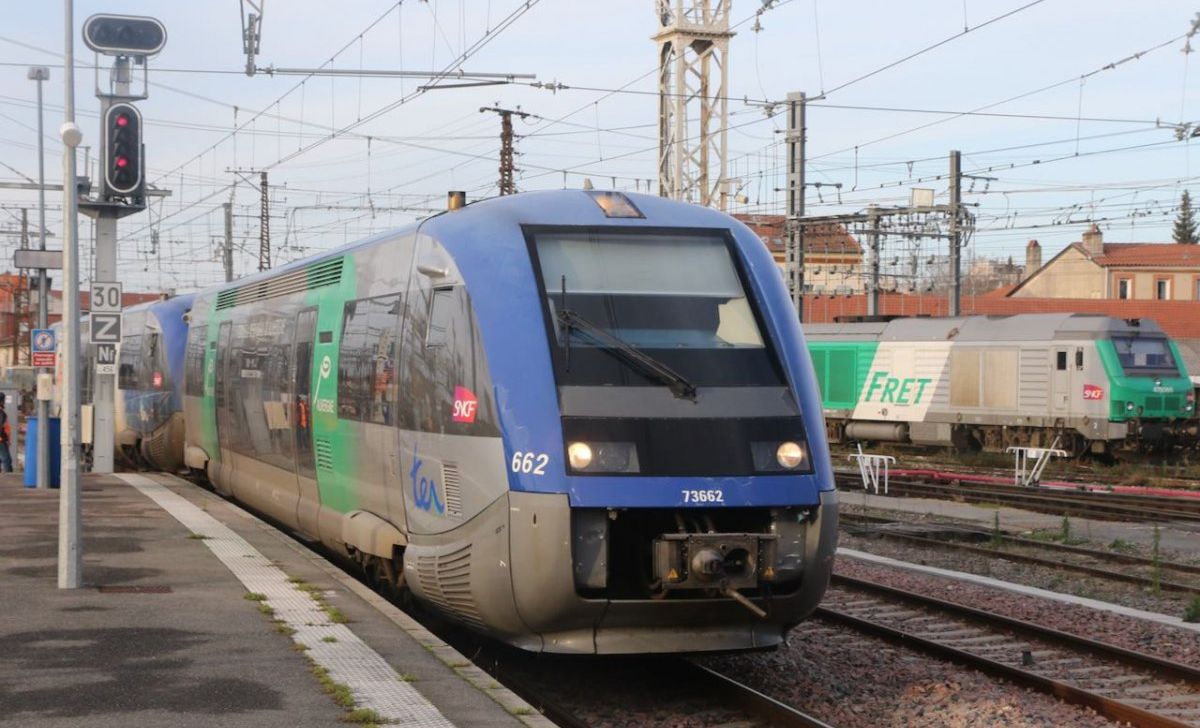
Opposite. X 73662 in Auvergne livery is seen entering Toulouse Matabiau station on 9 January 2017 in company with Rhône-Alpes liveried X 73667 on TER 871209 Clermont-Ferrand – Toulouse.
Photo: Georges Turpin.
CDG Express rolling stock arrives
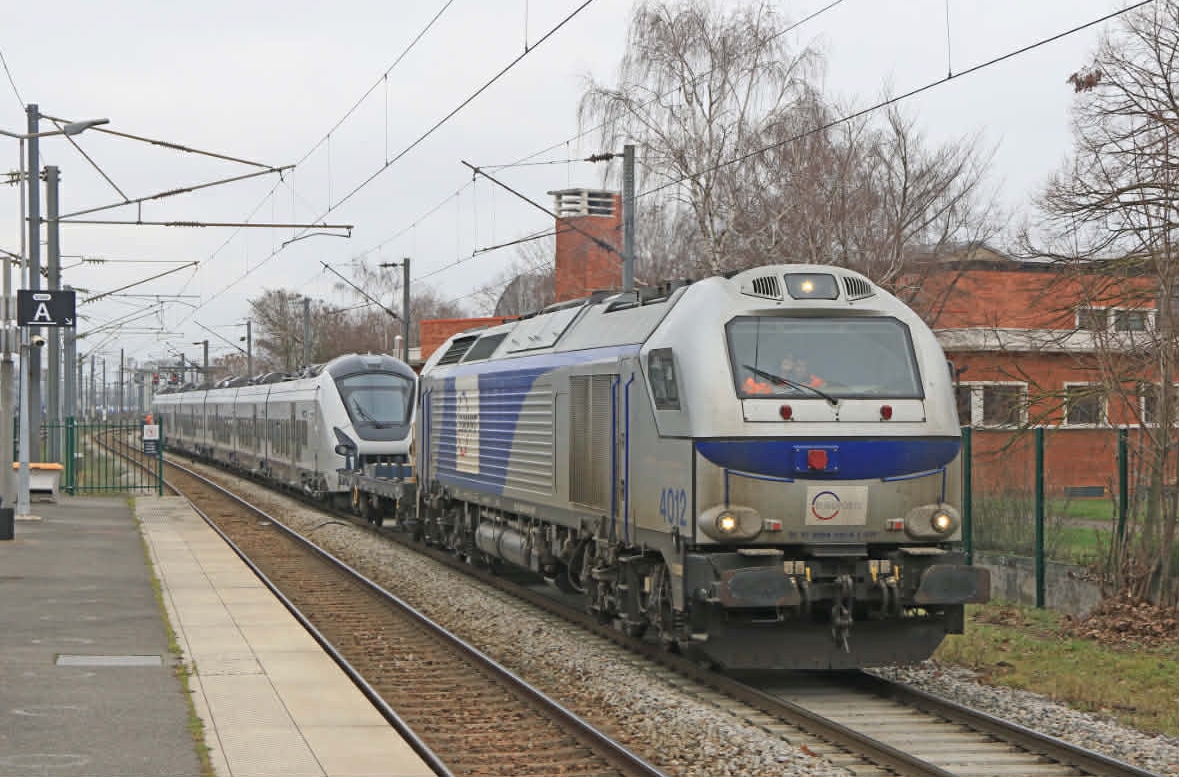
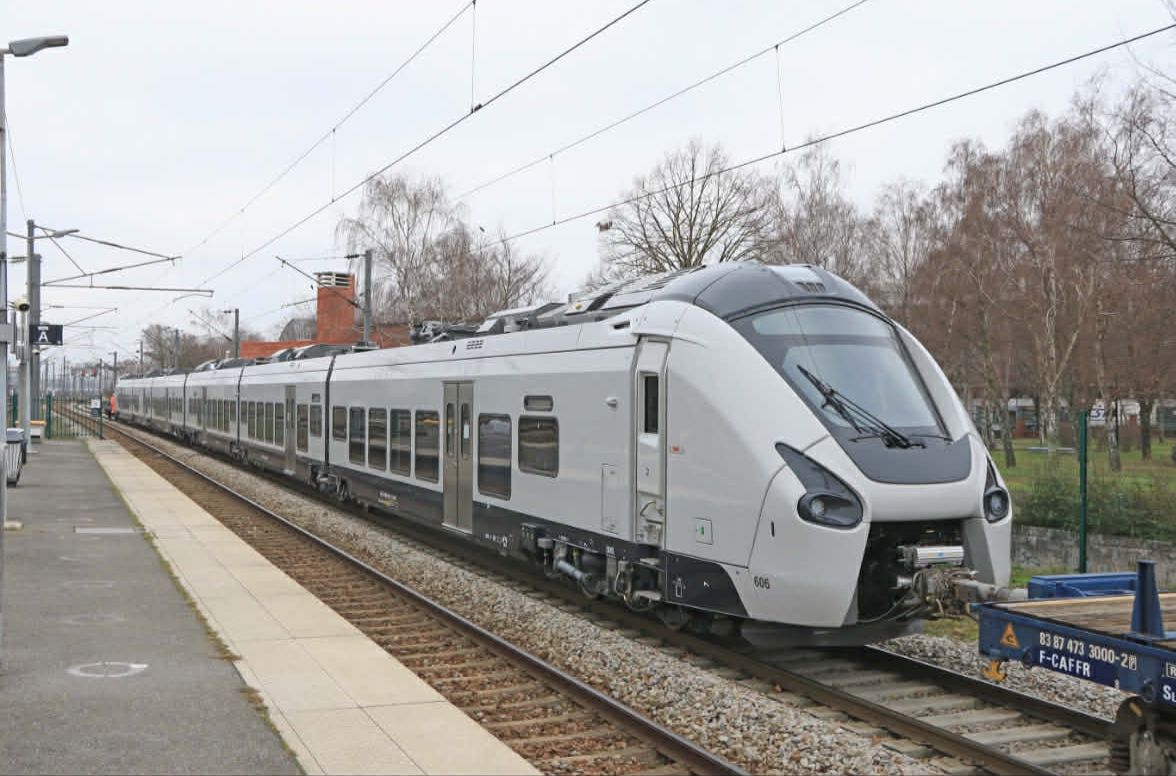
The first of 13 CAF Coradia Liners (Régiolis) for the CDG Express was delivered to Pantin Technicentre on 20 January from Reichshoffen where they have been in store 2022. With traction provided by Europorte E4012 set 606L (sub class Z 61600?) was still in base grey without the expected blue and red livery.
The small fleet dedicated to the CDG Express will consist of six 4-car and seven 6-car sets, and will connect Paris-Est to Roissy-Aéroport CDG 2 TGV. It will be run by new operator Hello Paris (EF HPS, a joint venture between RATP Dev and Keolis). Entry into service, repeatedly postponed, is now scheduled for 28 March 2027! Photos: Christophe Masse.
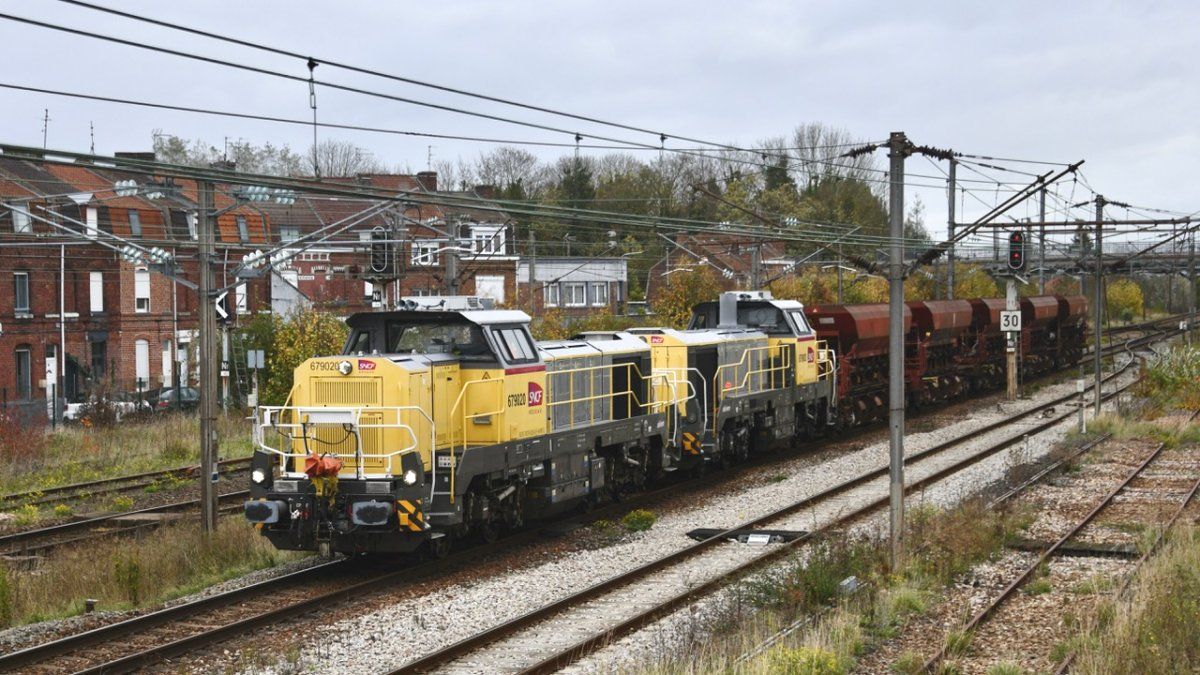
BB 79020 and 79003 are seen passing Armentières with Train 813701 Lille Délivrance – Calais Fréthun on 27 October 2025. SNCF Infra took delivery of 44 of these Vossloh DE18s between 2021 and 2023 for use on LGV infrastructure trains and replace the 60 year old BB 67200s. Numerous modifications were made to meet union demands and so far only a few BB 67200s (mainly with TVM 300 signalling) have been withdrawn, with 55 (virtually all with TVM 430 signalling) still in traffic. Photo: Didier Delattre.
Hexafret locomotive disposals
- Class BB 36300. 36332/334/336/341/346/347/349/350/353/354/355. The guide price is between €115-135,000 depending on kilometrage travelled (between 1.6m and 2.2m km) with some having not received a major examination since 2017.
- Class 60. 60016/077/099/111/107/116. All with a guide price of €400,000 except BB 60017 which is partially dismantled and offered for spares at €50,000.
- Class BB 75000. 75070/115/120/129/132. All with a guide price of €550,000. As part of the EU agreement these are being sold for commercial operation in France, without systems for use in other countries.
All of the locomotives are sold on an 'as seen' basis but examinations and overhauls are available from Technis as part of a separate contract following sale.
Paris sends buses to Ukraine
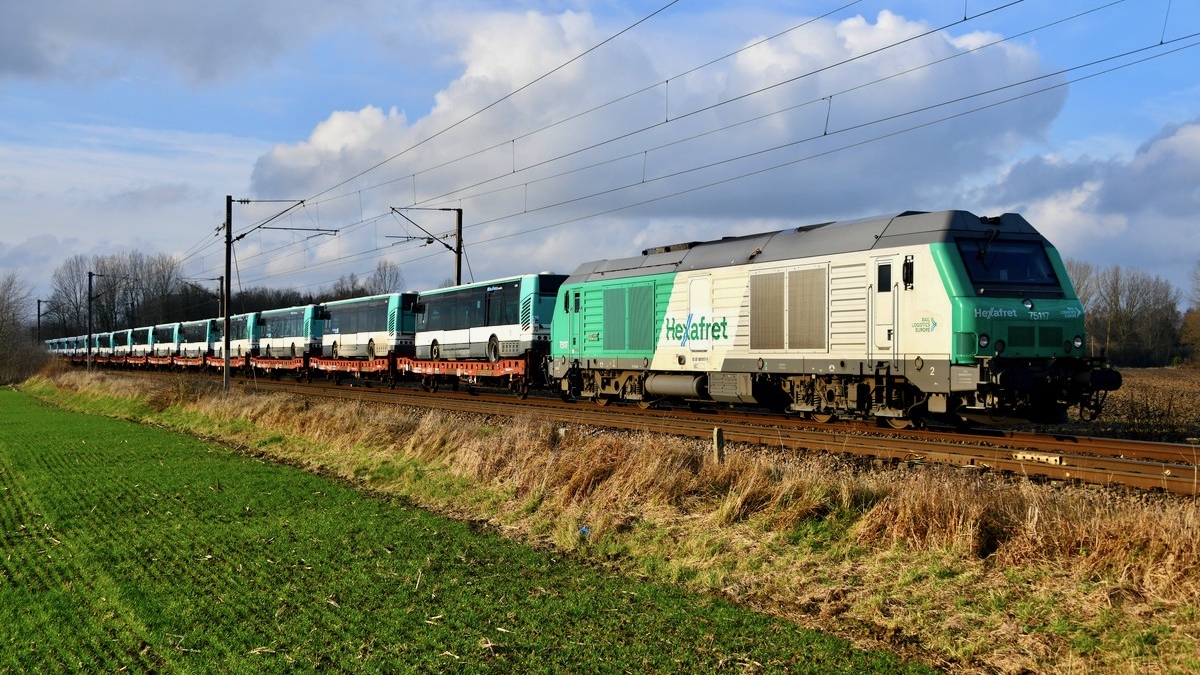
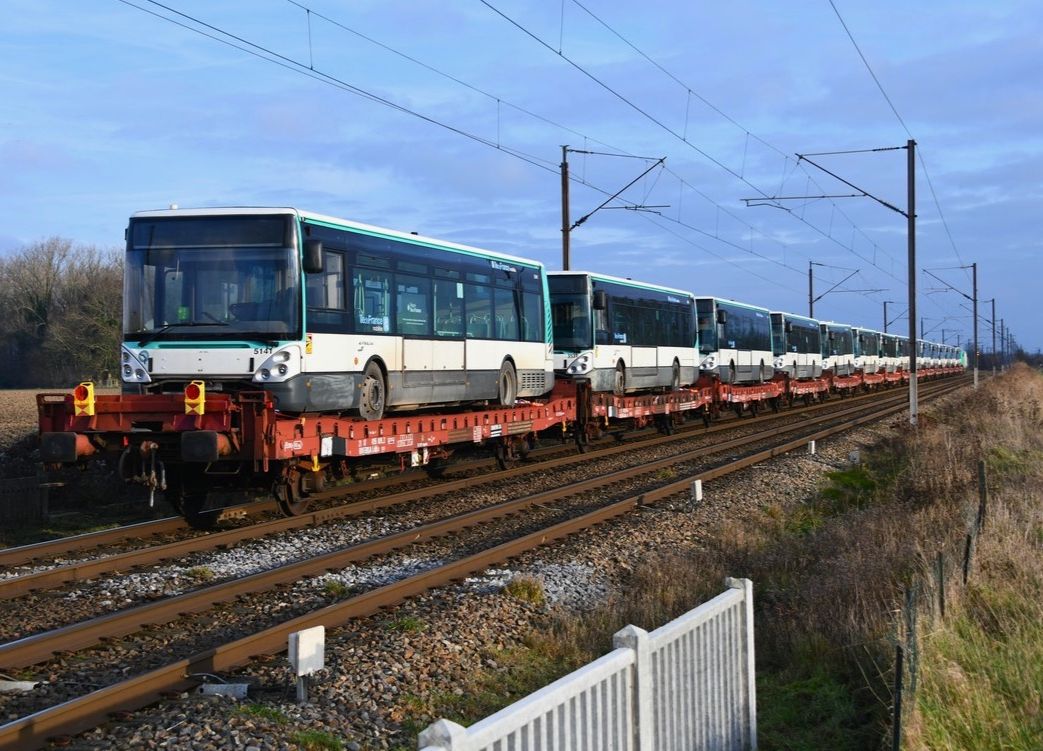
A batch of 30 obsolete Paris buses was delivered by rail to Ukraine in December in a joint operation organised by Rail Logistics Europe with Forwardis, Hexafret, Captrain Deutschland, Captrain Polska and Ukrainian Railways. Comprising two different types, the buses were loaded at Arras, with a separate train for each type, then initially moved to Somain running as Train 458113 14.47 Arras – Somain hauled by BB 75117, followed by Train 458111 16.21 Arras – Somain hauled by BB 75460. The buses then continued overnight into Germany and on to Zamość Bortatycze in eastern Poland where they were transhipped from standard to 1,520mm gauge wagons for the last stage of their journey to Kyiv and Chernihiv.
Photos. The first batch of buses is seen at the entrance to Somain Yard behind BB 75117. Photos: Didier Delattre.
Photos. The first batch of buses is seen at the entrance to Somain Yard behind BB 75117. Photos: Didier Delattre.
News in Brief
The loi-cadre (framework law, ie bill) on infrastructure financing is to be presented to the council of ministers on 4 February. Arising from the work of last summer’s Ambition France Transports commission (see August 2025 News), the bill seeks to establish for a 10-year period the means of financing renovation of the ageing national rail network (and other transport infrastructure). It will give transport the financial security currently accorded only to defence and research spending. The principal element is AFT’s recommendation that one-fifth of revenue (some €2.5 billion annually) from renegotiated motorway concessions be earmarked for transport infrastructure maintenance. With €1.5 billion more per year required by SNCF after 2028, of which €500 million is unfunded, the bill sees mobilisation of private capital as a way to make-up the shortfall between 2029 and 2031 when the new money is expected to start flowing. It also seeks to index local and urban transport fares to the annual inflation rate to leverage more income from passengers who are currently subsidised by around 75%.
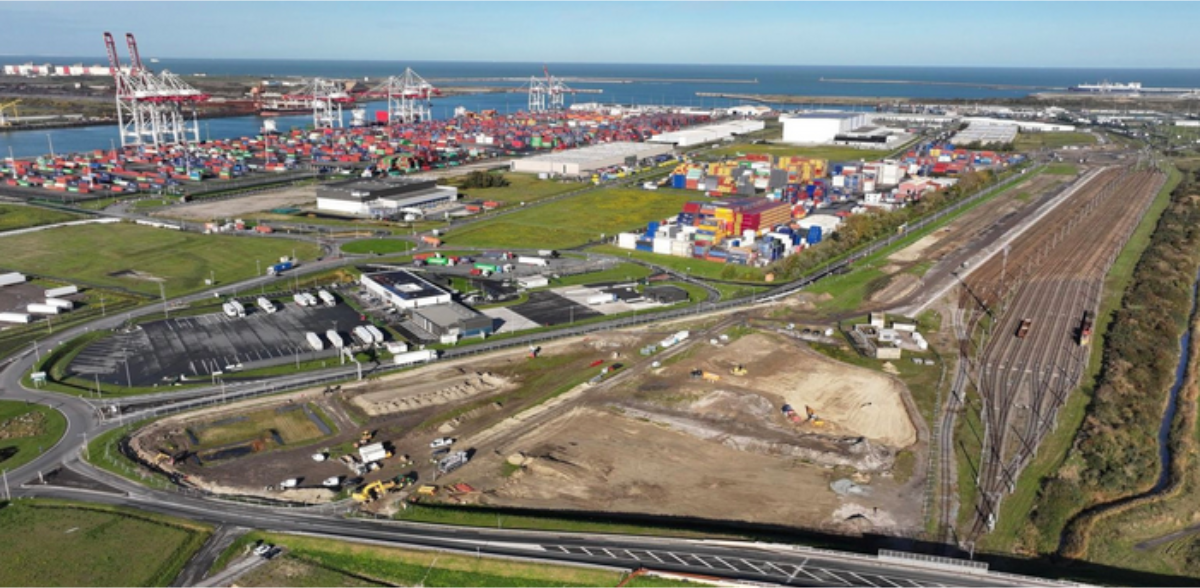
The Dunkerque port authorities began construction in November of a new intermodal terminal to open later this year at a cost of €25 million. Photo: Modalis/Dunkerque-Port.
SNCF Voyageurs ordered a further 15 Avelia Horizon (TGV M) four-current trainsets from Alstom on 19 January, bringing to 30 the number being supplied for European services. Together with the 30 sets for Eurostar, there are now 160 Avelias on order.
LNPN. Following the new accord between Normandie and Île-de-France regions, transport minister Philippe Tabarot chaired a meeting on 9 January at which he offered “the full support of the government for continuation of this project of national interest”. Agreement was reached on key elements: the new Rive-Gauche station in Rouen, four-tracking between Paris and Mantes-la-Jolie, and maintenance of stops by Normandie TERs at ÎdF stations. SNCF Réseau is to revise existing plans for a relaunch of the project this autumn, with public consultations likely in 2028.
LNPCA. Marseille – Genoa has been added to the TEN-T international network as an extension of the line from Barcelona, making the route eligible for funds from the Connecting Europe Facility.
Eurostar carried 500,000 more passengers in 2025, reaching a record 20 million of which 12.2 million on the London – Paris route (up 5%); London – Amsterdam journeys rose by 18% and Paris – Brussels by 3.7%.
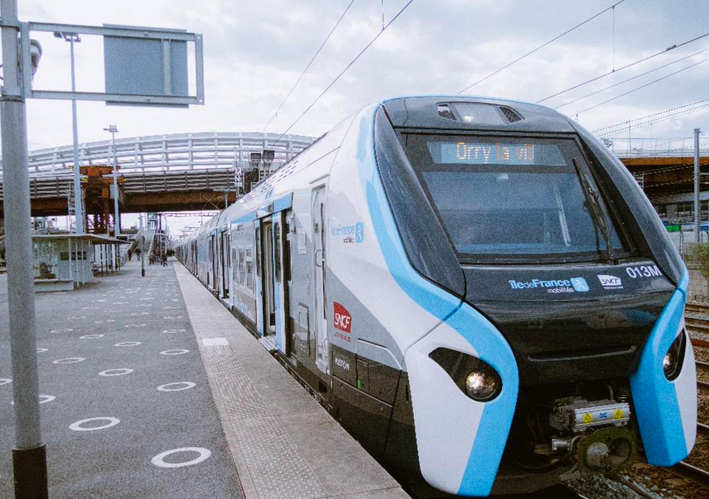
A year after their introduction on the Creil – Corbeil-Essonnes section of RER Line D, NG trains began running between Goussainville and Melun on 14 December. Of the 132 NG trains on order for Line D, 30 are in service so far. Photo: SNCF Voyageurs.
Corbigny. The A/R to and from Paris was withdrawn between Clamecy and Corbigny during November and December due to the poor state of the track, and has not reappeared in the winter timetable. The once-daily service over the 33km section, which had been limited to 30km/h since last summer’s heatwave, has ceased until renovation financed by Bourgogne-Franche-Comté’s emergency subvention of €3.6 million is undertaken, now scheduled for 2027.
‘No kids’ storm in a teacup. SNCF was attacked in the press and social media for excluding children under 12 from the Optimum Plus accommodation introduced on Paris – Lyon Inoui services in January, not a new policy but one carried over from the previous Business Premier offer. The families minister castigated the operator for ‘discrimination’. SNCF PDG Jean Castex said the furore was “…completely crazy. On our trains, not only are children welcome, but they are [travelling) more and more”. Only 39 seats are reserved for Optimum Plus passengers (who pay up to €180 one-way) and only on weekdays, TGV Inoui director Gaëlle Babault said. She regretted an “unfortunate marketing error” in drawing attention to the restriction, which was later removed from publicity though the ban remains. Observers pointed out that dogs are permitted in Optimum Plus for the usual €10 supplement.

Train + Vélo. Occitanie région is offering regular travellers long-term cycle hire at stations on the Montpellier – Sète and Montauban – Toulouse routes; six, nine or 12 months’ rental with helmet, anti-theft lock and secure storage. Painted in ilO livery, classic bikes start at €15/month, electric from €25.
Photo: Région Occitanie.
SNCF has changed the November timing of pay negotiations in the hope of avoiding strikes over the Christmas and new year holidays. Talks now start in mid January. For 2026, an increase of 0.5% has been offered, plus improvements to supplementary benefits, seniority payments and incentives which take the average rise to 2.6%. The intention is that no one will receive less than the minimum industrial wage (€1,802 per month) plus 10%. On 14 January members of parliament approved a bill to limit the right to strike for public transport workers during ‘sensitive’ periods such as holidays and major events.
European Sleeper launched its latest crowdfunding exercise on 13 January, aiming to raise €1 million to finance its Paris – Berlin night train planned to start at the end of March, and the proposed Amsterdam – Milan service.
AFNT. A court ruling on 29 December dismissed objections on environmental grounds to the northern Toulouse four-tracking project which SNCF Réseau said was now 25% complete. Widening at the site of the halte at Launaguet was underway at the end of the year.
The Nice – Breil-sur-Roya line reopened on 15 December after a 15-month infrastructure upgrade. Apart from the two daily through Train de Merveilles, the Nice – Breil service connects with Trenitalia trains or buses to Tende.
Centre-Val de Loire has augmented its Paris – Châteaudun – Vendôme – Tours TER service to cope with 10% annual growth in patronage. A new 06.25 Paris Austerlitz – Châteaudun A/R brings the daily total to seven, and there are two additional Vendôme – Tours A/R. Summer extras in the Loire valley will run from June to September, not just during school holidays. The station at Fondettes Saint-Cyr-sur-Loire reopened on 14 December with seven A/R to Tours.
Work started in December on projects to reduce by one-third the 80 daily ECS movements between Tours station and Saint-Pierre-des-Corps Technicentre to free-up capacity for additional services. Tasks carried out at the Technicentre will be transferred to the Chantier de Bordeaux at Tours station throat which is being redeveloped as a light maintenance depot. Access will be improved for ECS to the Chantier PV on the east side of the station, and the train-washing depot modernised. Total cost is €7.5 million.
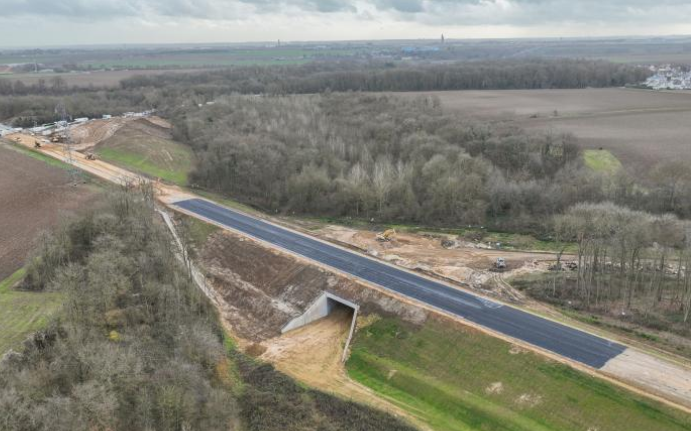
Roissy – Picardie link. Civil engineering work on the 6.5km connection between the Nord-Est LGV north of Roissy-Aéroport-CDG and the Paris – Amiens classic line (see February 2024 News) is 90% complete. SNCF said, with tracklaying and installation of OHE starting this summer. Opening is still almost three years away, scheduled for 10 December 2028. Photo: SNCF Réseau.
Ouigo Espãna cancelled several trains daily on the Madrid – Seville/Malaga routes for two weeks during January due to rolling stock shortage caused by changed maintenance schedules. The time allotted for daily maintenance was increased from 1 January. Renfe put on additional trains to compensate, including two Madrid – Seville at Ouigo fares, from €7.
Following termination last November of its operating contract with Cie du Mont-Blanc for the Tramway du Mont-Blanc, Haute-Savoie département agreed on 12 January to create a public body to manage the railway. Some elements will be shared with the Mer de Glace railway, though it is apparently legally impossible for the two to be managed jointly.
SNCF Réseau completed projects on the Paris – Lyon – Marseille classic line on 19 December: resignalling between Fain-lès-Montbard and Nuits-sous-Ravières (27km) in preparation for transfer of control to the CCR Dijon operations centre; installation of a second fibre-optic link between Blaisy-Bar and Dijon; reinforcement of the invert over 100m in Blaisy-Bar tunnel, along with fire protection work; replacement of 414 catenary masts between Dijon and Baulme-la-Roche; and renewal of 1.5 km of track between Saint-Florentin and Vergigny. Total cost €50 million. Visiting the EIV signalling works at Venaray-Les Laumes in Bourgogne-Franche-Comté on 7 January, SNCF PDG Jean Castex outlined investment of €2 billion in BFC’s railways over the coming five years, including further upgrading of the PLM route.
Military mobility. EC proposals for removing obstacles to cross-border movement of troops and military equipment were presented in November. A draft resolution on harmonisation of regulations and customs formalities is essential for readiness ‘to face possible Russian aggression’. The European Military Mobility Enhanced Response System (EMERS) will work towards a maximum three-day processing time for setting up cross-border movements, with a single ‘permission’ procedure covering all member states. For rail, four TEN-T routes designated as ‘dual-use corridors’ will be cleared to accommodate out-of-course loads, and infrastructure work on all TEN-T routes must reflect dual-use parameters; €17.6 billion expenditure is proposed under the 2028-34 Connecting Europe Facility for the necessary enhancements.
Stop please! SNCF Réseau will give track access-charge rebates to operators undertaking to serve the least-used TGV stations, the so-called champs de betteraves, park-and-rides in the middle of nowhere which today have 20% fewer trains than 10 years ago. The objective is encourage new entrants to do more than cherry-pick the most lucrative stations.
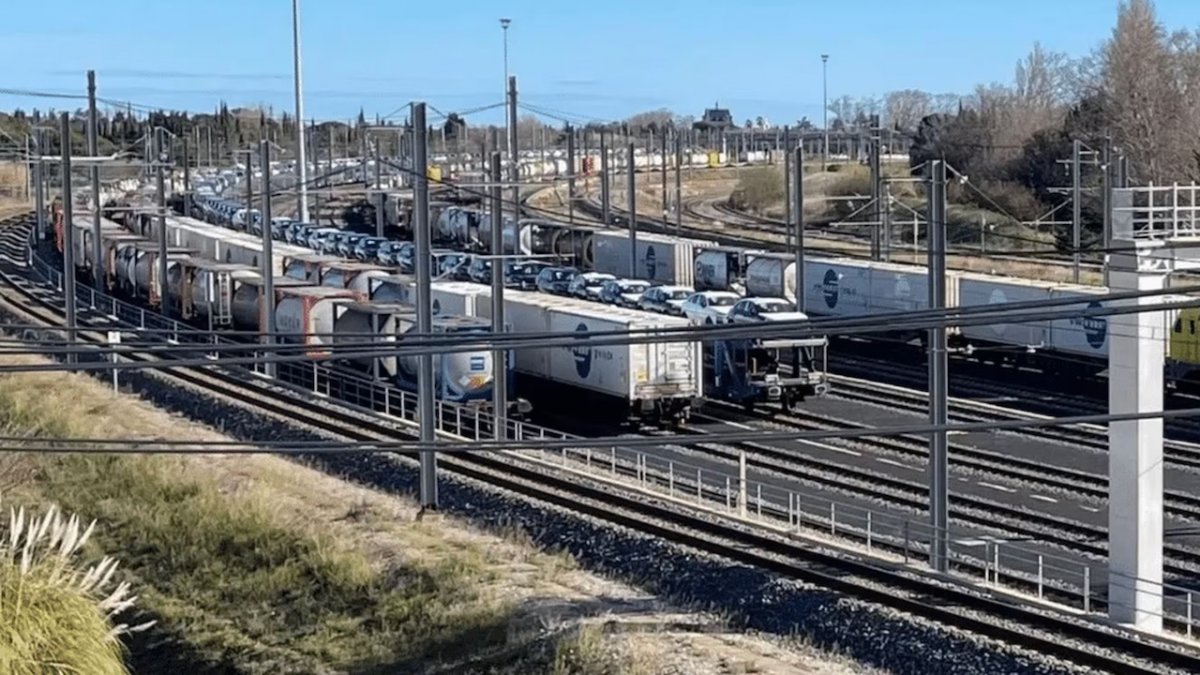
While Britain recovers from Storm Chandra, cross-border traffic in the south of France has been disrupted by Storm Harry that caused flooding in Catalonia and stopped all rail traffic travelling through the Perthus tunnel between France and Spain.
Hitting Spain on the 18 January, Storm Harry brought a week of heavy rainfall, flooding tracks and closing the Rubi tunnel south of Barcelona, preventing freight trains from bypassing the Catalan capital. With a dozen or so trains normally crossing the border, daily traffic soon built up. By 28 January the yard at Le Soler, Perpignan, was completely full with traffic needing to be held further back. Photo: Radio France/MR.
Industry News
A pressure-sensitive coating developed by Bordeaux start-up Touch Sensitivity is being tested on a bogie in service on Paris metro Line 13. The intelligent paint monitors in real-time pressure, tension, deformation, cracking, impacts and other damage to the coated area. Data is transmitted to a recorder which is then be downloaded at the depot.
SNCF will buy 20GWh annually of electricity produced by the Reden pv solar farm at Uchacq-et-Parentis in Les Landes in a 25-year agreement signed on 14 January. This is the entire output of the site which is located just outside Mont-de-Marsan. Last October, SNCF concluded two power purchase agreements for over 100GWh with BayWa re.
At the Marcheprime maintenance depot being built for Lisea (see January News), Colas Rail will install 3.5km of track and sidings, 30 points and crossings, signalling and 25kV/1.5kV traction power supply. The contract also covers equipping the maintenance workshop with a tandem underfloor wheel lathe, train washing machine, three drainage lines for trains, 28 mobile jacks, and an ultrasonic test bench.
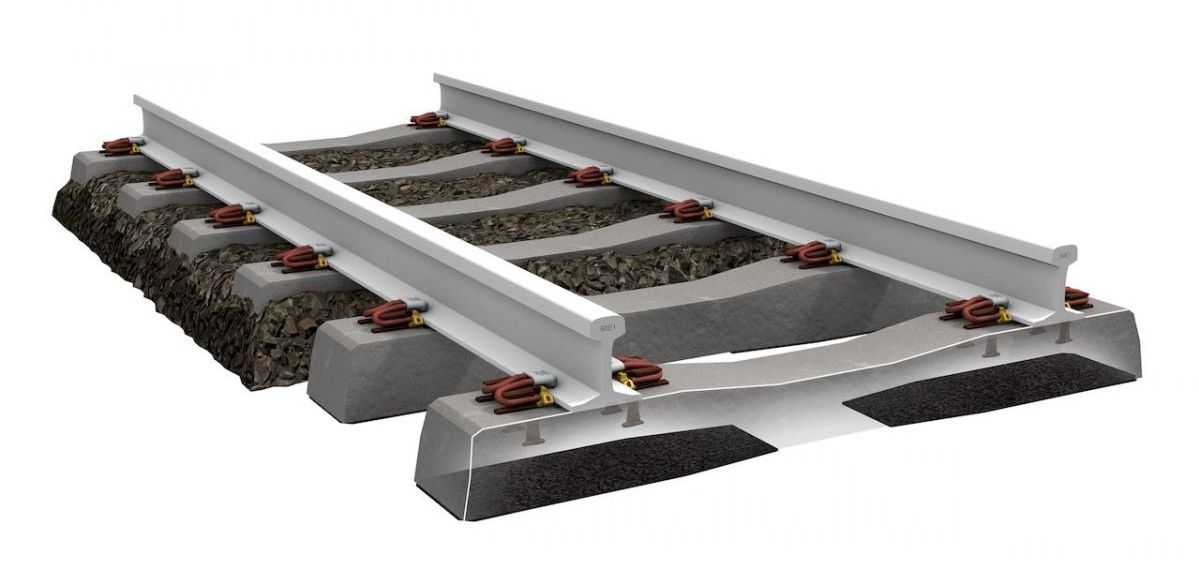
Pandrol. USP under-sleeper pads have been approved for use by SNCF Réseau after 18 months’ in-service trials. Made from recycled resin-bonded rubber, the pads are said to improve running quality, give better load distribution and reduce vibration.
Photo: Pandrol.
SNCF has awarded Vossloh Rail Services a two-year contract for track and turnout rail-grinding and profiling, renewable for up to three years. The work will cover some 200km of track annually.
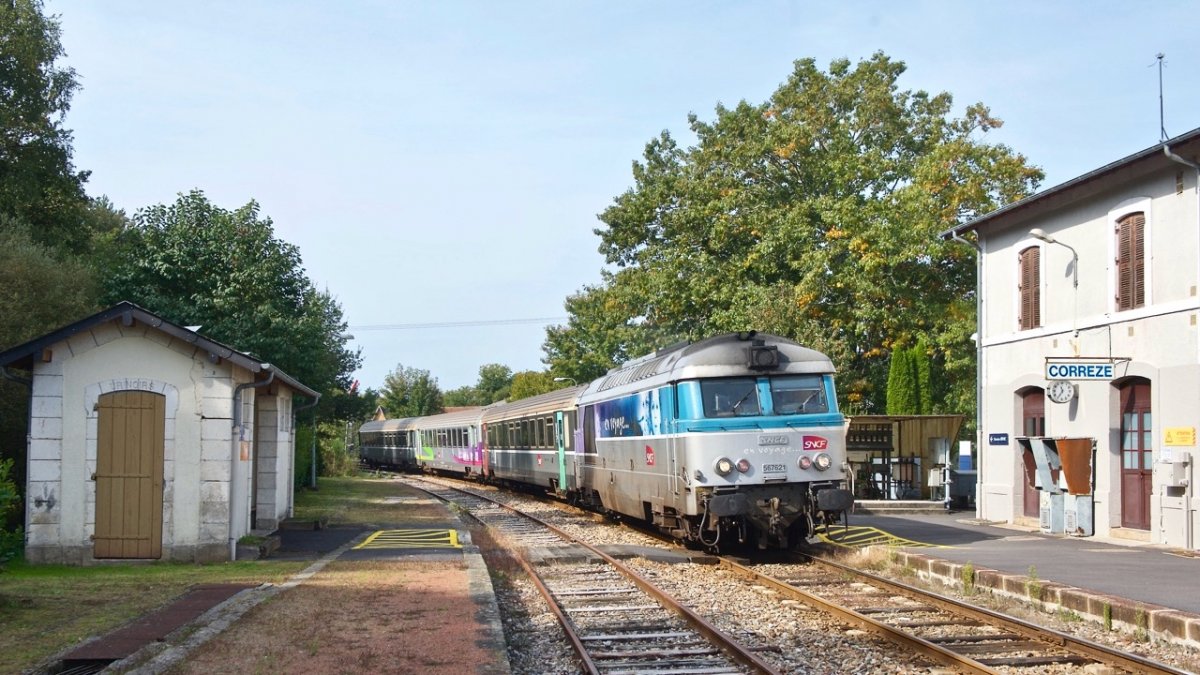
Vestige of the Ventadour: On 23 September 2017 BB 67621 with three scruffy Corail carriages arrives at Corrèze with IC 4496 the 08.31 Bordeaux – Ussel. This was the remnant of the once daily Bordeaux – Lyon Ventadour service, cut back to Clermont Ferrand in 2004, and then Ussel following closure of the section from Ussel to Laqueuille in 2014. At Ussel it connected with a bus to Clermont-Ferrand. By this time it ran at weekends only, a return trip on a Friday, then outward to Ussel on Saturday, returning to Bordeaux on Sunday afternoon.
AURA seeks Massif Central master plan
Instead, Aguilar wants a co-ordinated master plan for regeneration of lines in the Massif Central. Recalling the 1970s motorway programme that brought vastly improved roads to the area, he asked Nouvelle-Aquitaine and Occitanie régions to join AURA in seeking a similar State commitment to rehabilitation of existing and recently-closed lines that serve 23 départements with a population of nearly 4 million. Centrepiece would be reopening the 84km between Volvic and Ussel, closed in 2016, to restore the classic route between Lyon and Bordeaux.
When asked about the Ouigo and IC proposals during his meeting at Clermont-Ferrand on 17 December (see January News), SNCF PDG Jean Castex said Ouigo was aiming for a million passengers a year, whereas the direct Lyon – Bordeaux route via Ussel had only carried 100,000 annually: “They are entirely different propositions”. He pointed out that AURA should be petitioning the State rather than SNCF, and “if the State says so, we will do it right away”. The €700 million additional funding he announced for 2028 would be specifically for ‘regeneration of rural lines’.
Nouvelle-Aquitaine ends State ‘compensation’
Lagrave feared the move would precipitate line closures and he ruled out reopening the Angoulême – Limoges line. “At €260 million, I can’t see it happening in the next four or five years”. In fact, the cost is even higher as €100 million also needs to be spent on future-proofing the Saillat Chassenon to Limoges section, still served by half-a-dozen trains daily. Several other lines are on the ‘at risk’ list, including Agen – Périgueux.
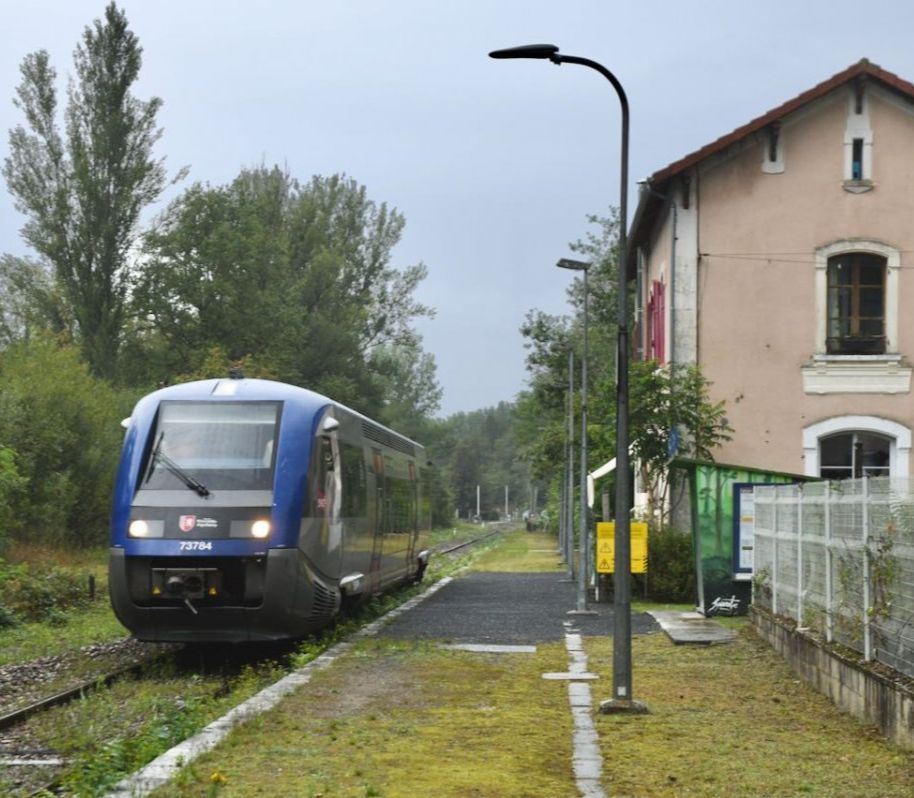
On 4 September 2025 X 73784 arrives at Villefranche du Périgord with the 09.41 Périgueux – Agen. With no one joining and none of the handful of passengers onboard alighting the doors remained closed. The unit then formed the 14.28 Agen – Périgueux return service.
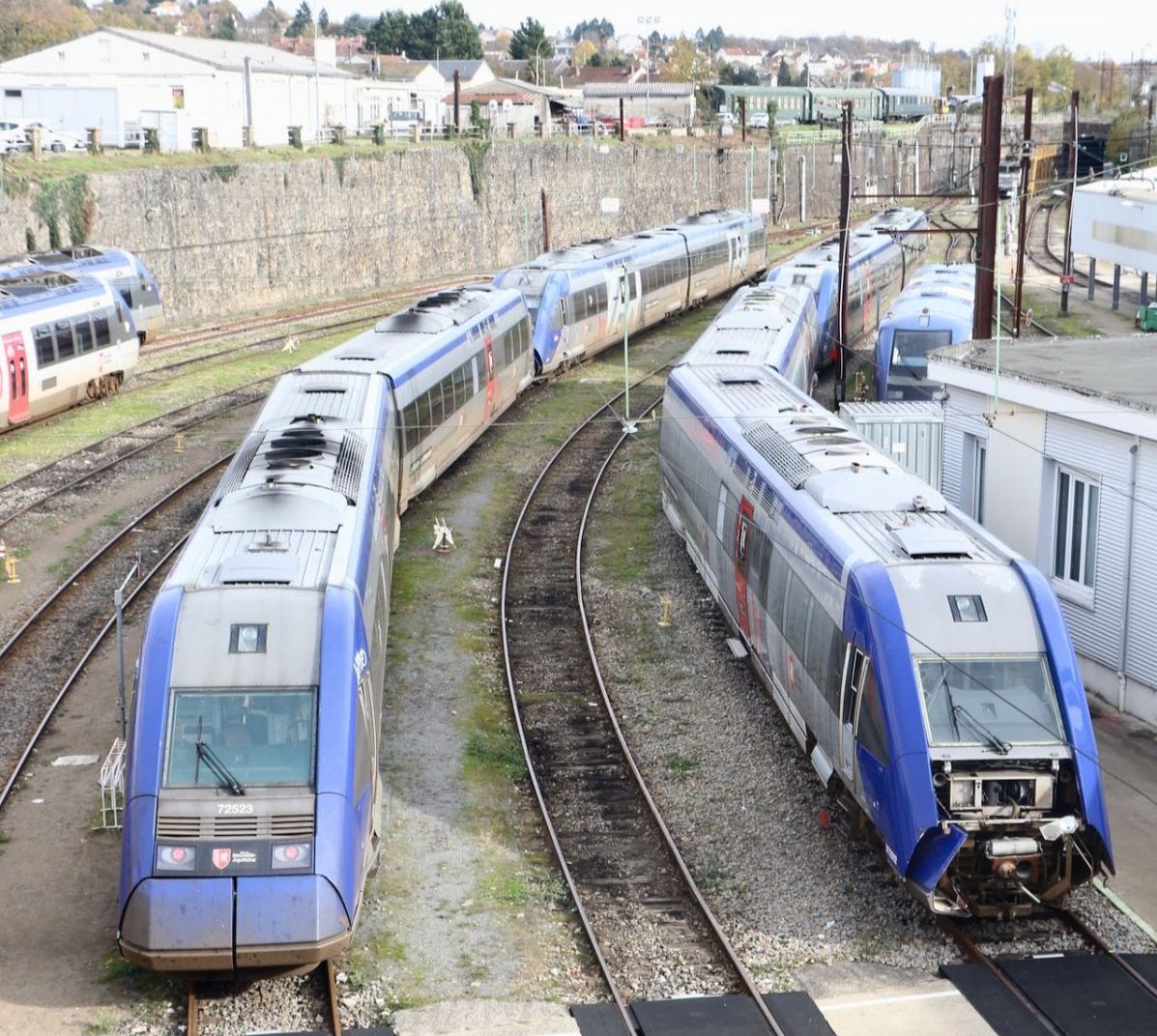
A line-up of NA TER X 72500s at their home depot of Limoges on 12 November 2025. Photo: Georges Turpin.
Rolling stock. On 15 January, SNCF Voyageurs announced a further order for 10 Régiolis MUs from CAF at a cost of €80 million, destined for service in Nouvelle-Aquitaine. To be built at CAF’s Reichshoffen plant, they will have bogies, traction motors and onboard equipment supplied by Alstom. The latest variant has a second accessible toilet. This batch will replace the 14 unreliable X 72500 DMUs still in service in NA. Nine others are in storage at Limoges, some cannibalised for spare parts. These trains operate from Limoges to Périgueux and Bordeaux, Poitiers and Brive.
This order follows commissioning last year of 12 such trains and will bring the NA Régiolis fleet to 54. Together with ongoing delivery of six Regio 2N EMUs ordered in 2022, the 16 new trains bring considerable relief to the rolling stock shortage. New four-car Régiolis B 84800s (so designated as they are ERTMS-equipped) are replacing three-car B 81500s on the Mont-de-Marsan service which is often standing-room only at main line stations en route to Bordeaux. Other overcrowded trains will be strengthened.
In the next stage of the région’s €20 million plan to take over ticket sales from SNCF Voyageurs, the first Modalis vending machine was commissioned at Bordeaux Saint-Jean (salle Belcier) on 16 December. By the end of next year, all TER ticket sales will be handled through the Modalis app.
Built at a cost of €7 million, the multimodal interchange (PEM) at Saint-Vincent-de-Tyrosse opened on 15 January, preparing the station for its role in the Basco-Landais SERM. From 2032, there will be trains every 30min to Dax, Bayonne and across the Spanish border to Saint-Sébastien. The event was marked by protests as the Down platform is still inaccessible to persons with reduced mobility; an accessible footbridge will be built in a later phase. Between Puyoô and Bayonne, Urt is also to be developed as a PEM, while the stations at Labouheyre, Sainte-Foy-la-Grande and Libourne will be made fully accessible
This order follows commissioning last year of 12 such trains and will bring the NA Régiolis fleet to 54. Together with ongoing delivery of six Regio 2N EMUs ordered in 2022, the 16 new trains bring considerable relief to the rolling stock shortage. New four-car Régiolis B 84800s (so designated as they are ERTMS-equipped) are replacing three-car B 81500s on the Mont-de-Marsan service which is often standing-room only at main line stations en route to Bordeaux. Other overcrowded trains will be strengthened.
In the next stage of the région’s €20 million plan to take over ticket sales from SNCF Voyageurs, the first Modalis vending machine was commissioned at Bordeaux Saint-Jean (salle Belcier) on 16 December. By the end of next year, all TER ticket sales will be handled through the Modalis app.
Built at a cost of €7 million, the multimodal interchange (PEM) at Saint-Vincent-de-Tyrosse opened on 15 January, preparing the station for its role in the Basco-Landais SERM. From 2032, there will be trains every 30min to Dax, Bayonne and across the Spanish border to Saint-Sébastien. The event was marked by protests as the Down platform is still inaccessible to persons with reduced mobility; an accessible footbridge will be built in a later phase. Between Puyoô and Bayonne, Urt is also to be developed as a PEM, while the stations at Labouheyre, Sainte-Foy-la-Grande and Libourne will be made fully accessible
Mulhouse Developments
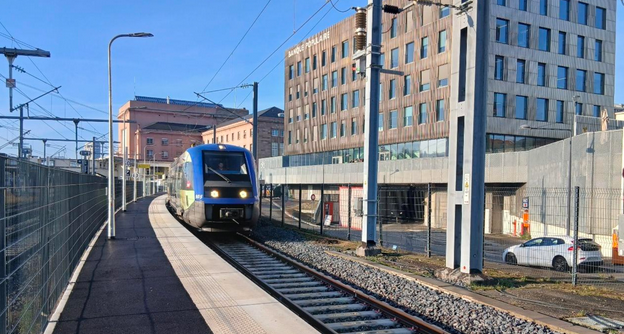
A six-year modernisation of the station and its approaches was completed in December. €141 million has been spent to improve capacity and throughput at the second-busiest station in Alsace, handling 300 trains daily and 5.7 million passengers/year. The track layout and signalling dating from 1957 was unsuitable for today’s traffic flows, with the eight through platforms not accessible from all routes. The layout has been completely replanned to reduce conflicting movements and allow simultaneous arrivals and departures; 19 new turnouts have been installed raising line speed in the station area from 40km/h to 60km/h. Signalling has been renewed, with control of the station transferred last June to Strasbourg CCR. Signalling installations nearby at Mulhouse-Dornach and Brunstatt have been modernised.
Platforms 1 to 7 have been extended to 400m so that all can accommodate pairs of TGVs. A major improvement is new bay platform Voie 32 (above left), created by lengthening Voie 1 and demolishing one of the signalboxes. The bay will be used by trains to Müllheim, which now have a dedicated track to separate trains bound for Germany from other routes; this will eventually permit doubling of the service to hourly.
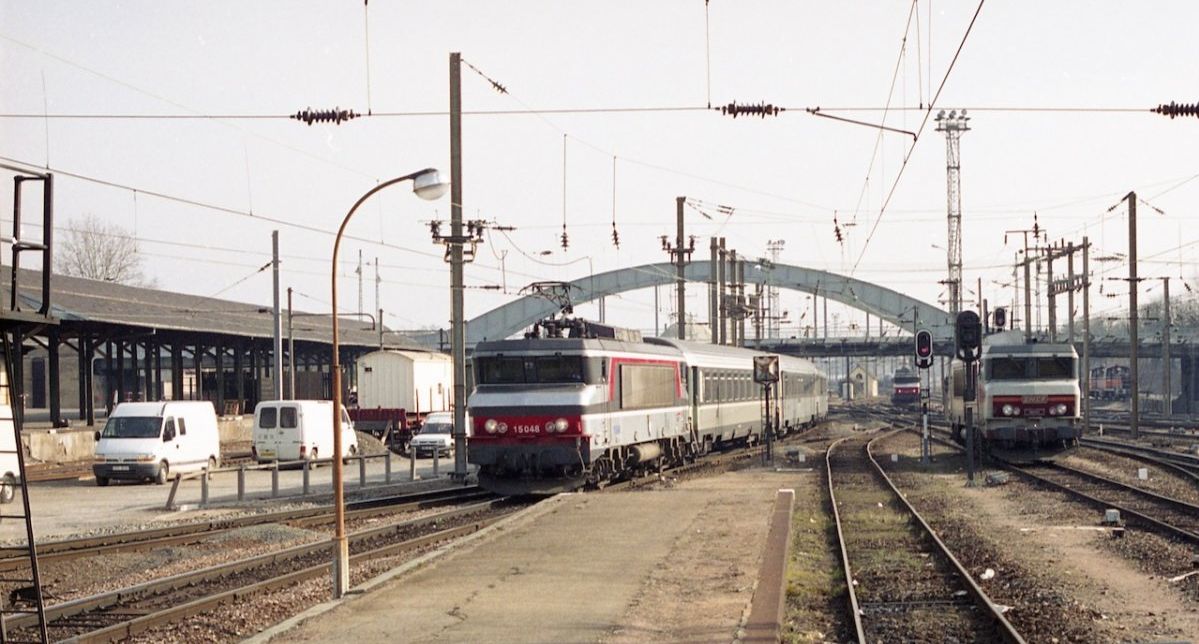
The photo, above right, shows the east end of the station where the development has taken place in 2002, but from the opposite direction. A Paris-bound train is seen arriving from Basle. The area on the left hand side has been completely redeveloped, the former goods shed having been replaced by tower blocks. Beyond the road bridge the Alsace Technicentre has been built. Photo left: SNCF Réseau.
Fnaut’s national reopening plan
A total of 49 lines of between 7 and 90 route-km are prioritised for reopening over the coming 15 years at a cost of €4.8 billion; 25% of the lines could become part of the SERM networks already planned for major cities. There are proposals in all 12 régions including some cross-border links, many of them already on ‘wish’ lists. Lines at risk of closure are also assessed and suggestions put forward for their safeguarding. In Fnaut’s view, the country’s huge investment over decades in LGV, nuclear power, motorways and other national infrastructure illuminates an ‘anti-rail bias’ which is disguised by the State’s current financial difficulties. The full report can be seen at: https://www.fnaut.fr/uploads/2026/01/PNRL-version-12-decembre-2025.pdf
POLT latest
Work started on 5 January on the next stage of the Paris – Orléans – Limoges – Toulouse upgrade, between Lothiers, south of Chäteauroux, and La Souterraine. The 61km section will see renewal of rail, sleepers and ballast over 43km of voie 2 (Up) and 8km of voie 1 (Down). At the same time, between Lothiers and Argentan-sur-Creuse (14km), catenary will be strengthened, track realigned, and the power supply augmented to raise line speed to 200km/h. This is the most significant investment here since 1977 and is aimed at restoring with Oxygène trains the 3h running time between Paris and Orléans that was usual in the days of the crack Paris – Toulouse Le Capitole. Completion is scheduled for 30 May; cost is €78 million.
The work is being carried out over five nights a week using a factory-train which can relay 1km per eight-hour shift. Fewer trains are cut than during last year’s phase of activity when work was done during the day. First and last Paris – Toulouse trains are suspended on weekdays, as is the Aurillac night train. Elsewhere on the route, this year’s programme will see new or continued infrastructure work at six locations south of Brive-la-Gaillarde, north and south of Orléans, and in the Paris outer-suburban area. Several stations are being made fully accessible, including Orléans, Limoges, Uzerche and Souillac, at a cost of €51 million.
North of Orléans, relaying between Fleury-les-Aubrais and Boisseaux is nearing completion after a year’s work, with normal daytime services resuming on 30 March.
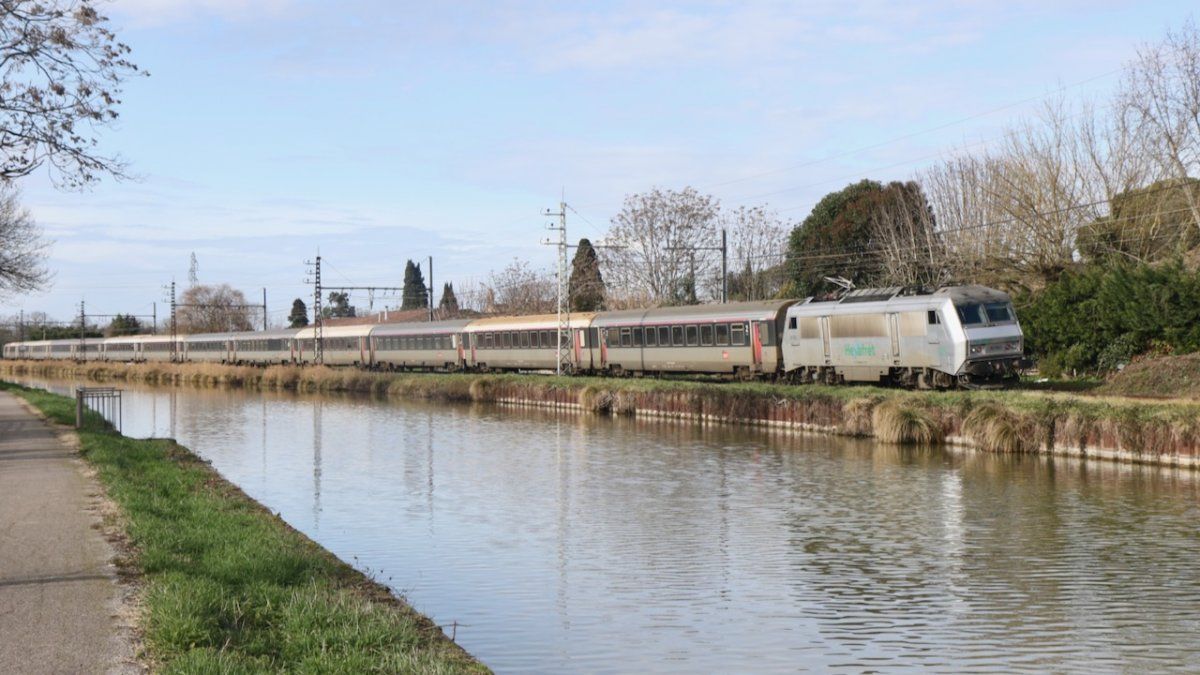
During January SNCF Voyaguers hired three Hexafret BB 26000 Sybics for use on POLT services. On 30 January BB 26060 in Hexafret livery passes the canal latéral à la Garonne at Pompignan on time with IC 3619 08.25 Paris – Toulouse. Photo: Georges Turpin.
Établissement Oxygène. This SNCF subsidiary started work on 1 January to prepare the incumbent’s bid for the contract to run Paris – Clermont-Ferrand and POLT services when they are opened to competition next year. As reported last month, train crew at Clermont are now restricted to either IC or TER duties, with consequent loss of flexibility. IC crew were reported to be without work on some days, whilst TERs were cancelled due to crew shortage. Staff went on strike on 18 January in protest at redundancies and the demotion of conductors on Oxygène trains, who will lose their safety role and be responsible only for commercial activities. Clermont – Paris trains ran with fewer coaches during January as the 50-year-old Corails succumbed to the effects of the severe winter weather.
Faur line-up
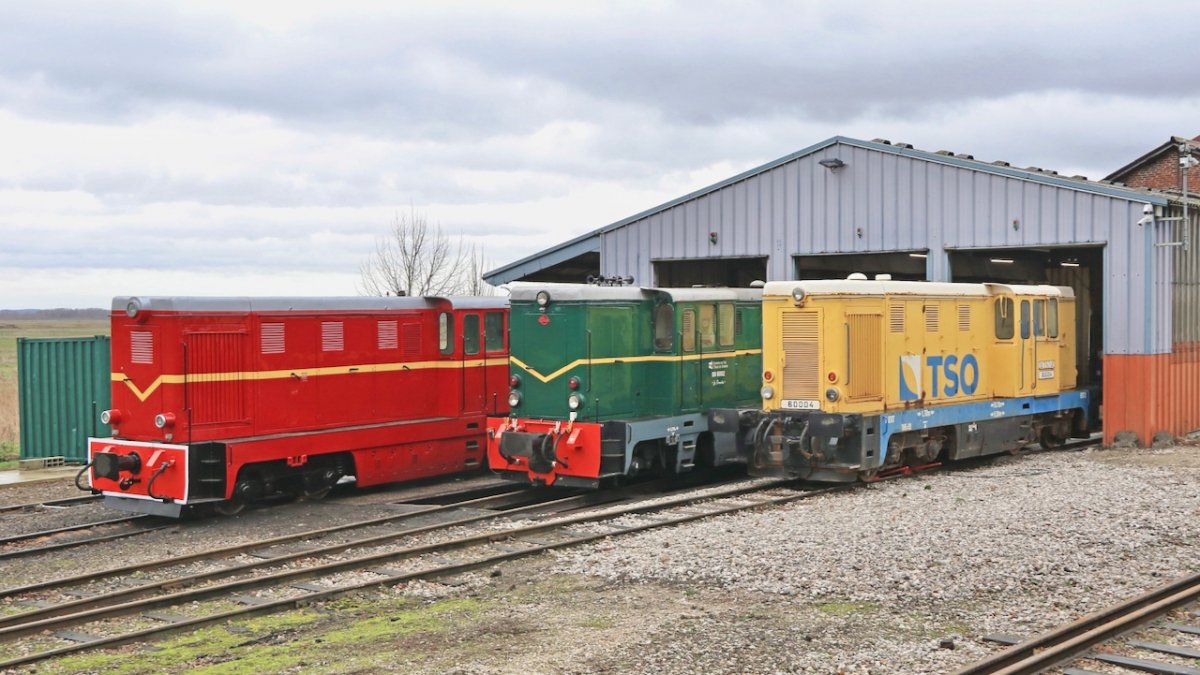
On 15 January CFBS organised a line-up of Romanian-built Faur L45H locomotives at Saint-Valery depot. Alongside the CFBS's resident Faur (in the centre) was newly-acquired former PKP 326 repainted in its original Polish red livery. It is in good mechanical condition, having been little used since an overhaul some years ago, but will require wheel reprofiling due to excessively-thick flanges.
Also on display was TSO 60004. This is one of three TSO Faur locomotives repatriated from Senegal where they had been used on construction of the Dakar – Diamniadio TER line opened in 2021. They had been unused since 2020 and were at risk of being scrapped. Initially they will be stored by CFBS as they are in poor mechanical condition and cannot be used with CFBS stock, having double buffers and incompatible couplings. Since its arrival in 2015, the CFBS Faur 'Dracolas' (previously a Colas locomotive) has carried the number 60002. This was found to be an error in the locomotive’s log book. It now transpires that it is 60008, the real 60002 having arrived from Senegal. The third member of the TSO trio is 60005. Photo: Christophe Masse.

CC 72084. APPMF have announced a railtour on 11 April from Vierzon to Montluçon. With CC 65512 unavailable due to an axle problem, traction will be provided by CC 72084. Coaching stock will be CTFLP's green rake normally used on the sunday steam specials from Limoges. Outline timings: Vierzon dep. 10.05 return 18.52. Montluçon arr.13.35 dep. 1608. includes 30 - 45 minute run round at Bourges. Details: appmf.fr
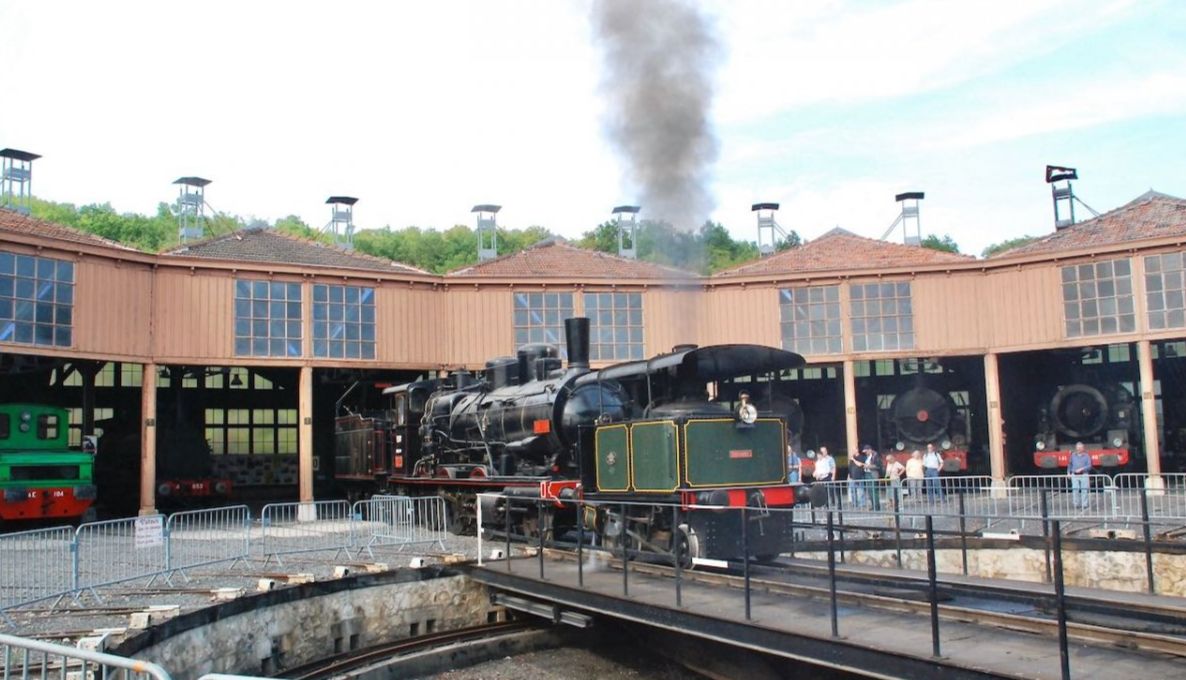
Longueville. Ajecta has been granted €300,000 by the Heritage Lottery towards the cost of renovating the roundhouse at its Longueville base. Dating from 1906, the building needs urgent repairs to the roof and structural timbers. The lottery grant brings the amount raised to €488,000. Above. Cockerill 'Suzanne' propels Est 300 476 (130 B 476) back into the roundhouse during the Society visit in September 2009. The energetic display by the little 0-2-0 is believed to have been the source of a fire in the roof later that evening.
Urban Rail
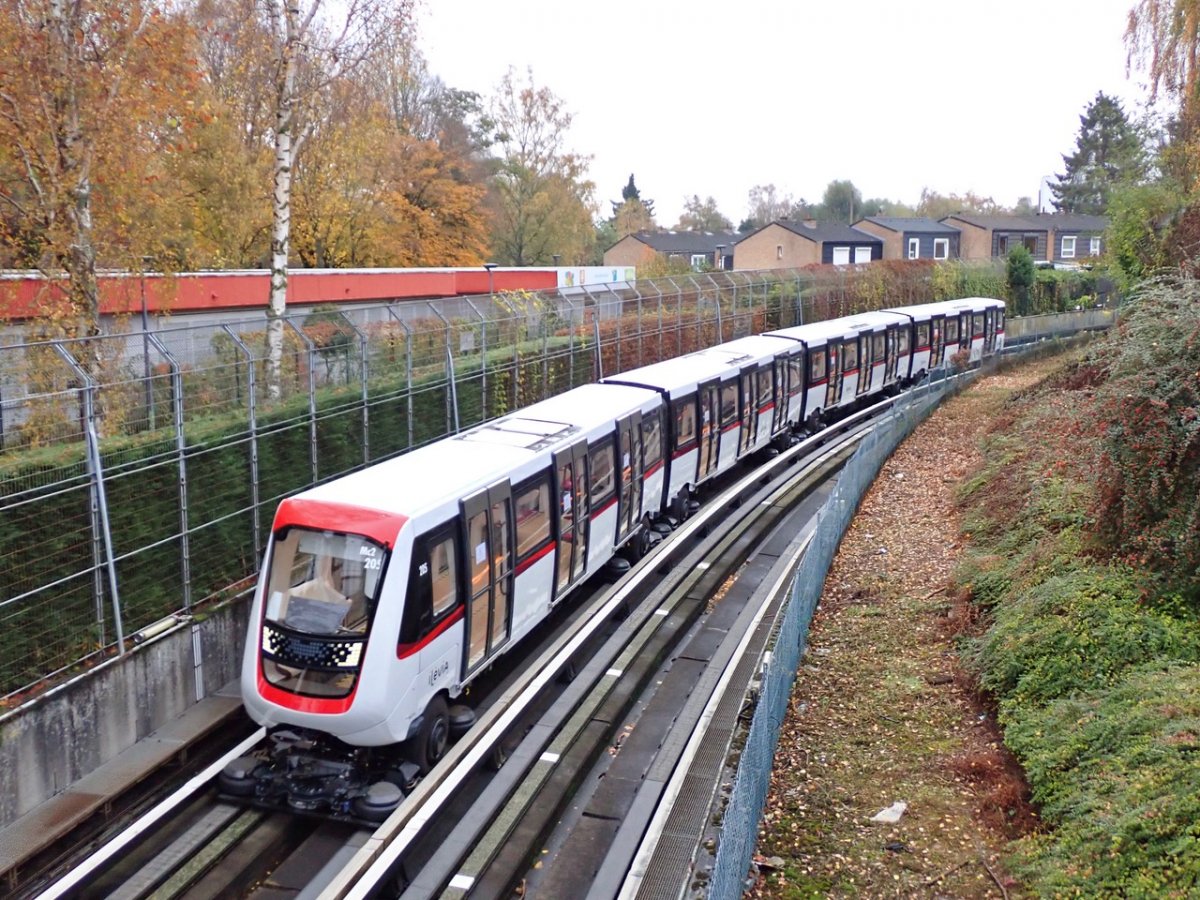
Lille. Now 10 years old and never having carried fare-paying passengers, Alstom’s BOA211 four-car trains for Line 1 are scheduled to enter public service on 14 February. Five of the new trains should be running from that day, increasing capacity by 13%. Numerous closures and frequent, sometimes daily, breakdowns occurred during trials to achieve compatibility with the original VAL208 stock and new control system. Closure on 11 November afforded an opportunity to see the trains in operation during daylight hours at Villeneuve-d’Ascq Triolo.
Photo: Didier Delattre.
Île-de-France. Opening of the first section of Grand Paris Express will be the high point of 2026 for Île-de-France Mobilités. Line 18 between Massy-Palaiseau and Christ de Saclay is set to open in October, giving passengers a taste of the new journey opportunities afforded by the entire 175km four-line network, as well as the stunning station architecture.
ÎdFM is pressing on with modernisation and upgrading to accommodate new-generation metro and RER rolling stock, as well as automation of Line 13, with €3.8 billion being invested. Parts of Lines 4, 8 and 12 will be closed for periods during July and August; the Saint-Denis Université branch of Line 13 will shut for 18 days whilst the track is prepared for automation; and trains will not stop at Line 8’s République platforms during eight months’ renovation starting on 22 July. Following their withdrawal on the metro, issue of paper tickets for RER and Transilien services in Île-de-France will cease in June.
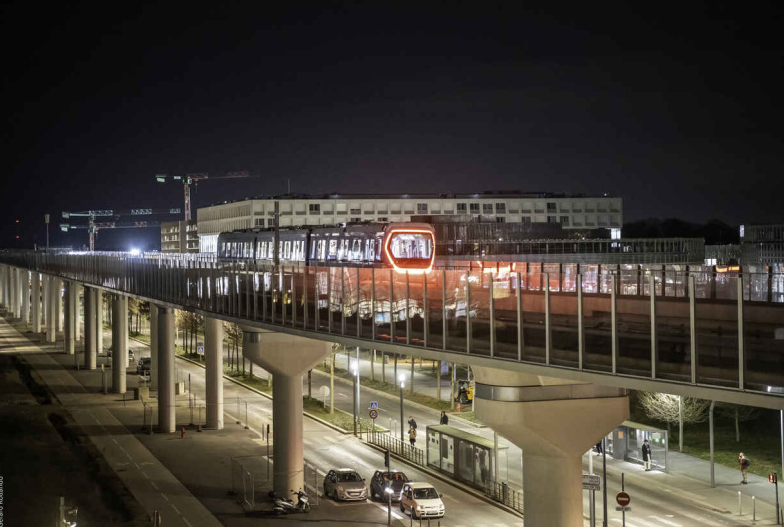
Trial running on Line 18 started in December. The 14km surface section includes the longest viaduct in France, 6.7km. Photo: Société des Grands Projets
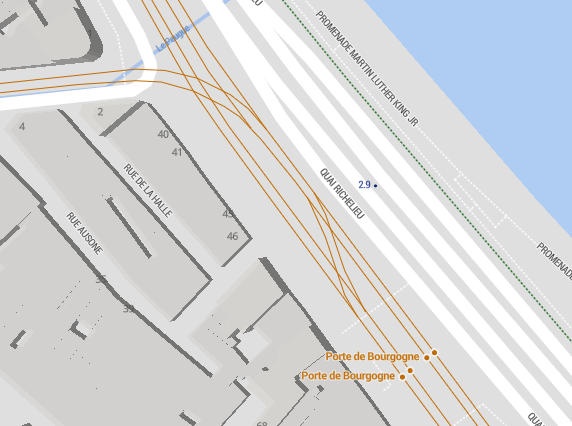
Disruption continued in Bordeaux as Keolis struggled with the new route structure introduced on 6 December. Some tram drivers went on strike in protest and Keolis conceded by adding 10min to diagrammed journey times from 5 January. Most of the problems occur at Porte de Bourgogne where five of the six routes meet and new Line F crosses from west (left on the map) to east and then back again, blocking all four tracks (see January News).
Map: © Carto Tchoo.
Tramway operators may equip cars with forward surveillance cameras to analyse front-end collisions with road vehicles and pedestrians for an experimental period until June 2028. Cameras will be positioned so as to avoid privacy issues, and their use will be ‘limited to prevention and analysis of accidents as well as staff training’, the transport ministry said. In 2024, there were 1,427 such collisions, leaving 10 dead and 31 seriously injured.
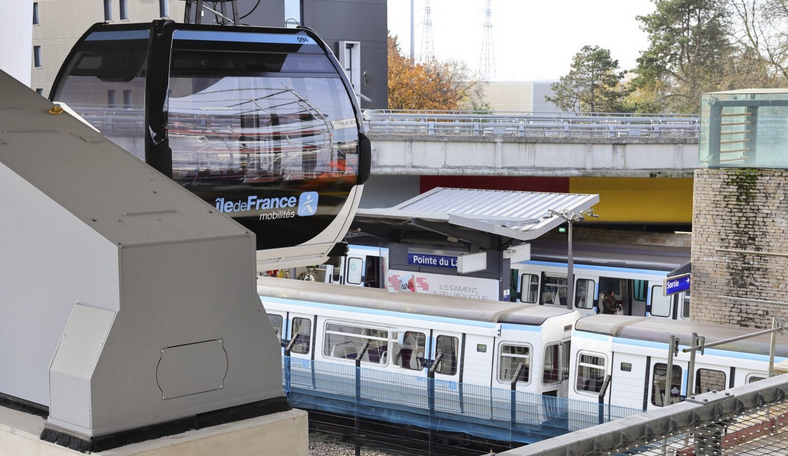
Câble 1. The first cable car in Île-de-France opened on 13 December linking Villeneuve-Saint-Georges, Limeil-Brévannes and Valenton with the southern terminus of metro Line 8 at Créteil-Pointe du Lac. Built at a cost of €132 million, the 4.5km link halves journey time to 18min compared with the bus connection to M8; cars run every 30sec at peak times. The service was an instant success, carrying 12,500 passengers daily after four weeks against the 11,000 forecast.
Photo: Île-de-France Mobilités.
RATP. Six months after he was given a second term as head of the RTE electricity transmission grid operator, Xavier Piechaczyk was confirmed on 27 January as the next PDG of RATP.
Toulouse. The underground link between Line C at Sept-Deniers and the construction site of Daturas maintenance depot was completed at the end of December. Photo: Tisséo.

Additions to FRS Photographic Archive during December 2025 and January 2026
To Photographic section
- Corrected/amended captions for the images in the ETH University Zurich gallery in Folder 1
- Re-organised certain galleries (John Blyth, Quanjer-Hesselink, Geoffrey Keen & David Thirlwall)
- Added FACS 425/Sept-Oct 2024 to Folder 12 of the archive
- LVDR 1515/Nov 1975 on SNCF 141R,
- LVDR 1792/May 1981 on Metz station & on Blainville/Lure
- LVDR 1794/May 1981 on Rouen have been added .
- Three missing FRS Journals (nos. 137, 138 & 139) have been added to the FRS Public Folde
- The four 2025 issues of the FRS Journal have been added to the Public Folder together with the corresponding index
© Peter Lovell & Chris Bushell. The French Railways Society 2026. With thanks to Georges Turpin, Christophe Masse, Didier Delattre Jean-Louis Poggi and Pierre Julien.
