
May 2026 News
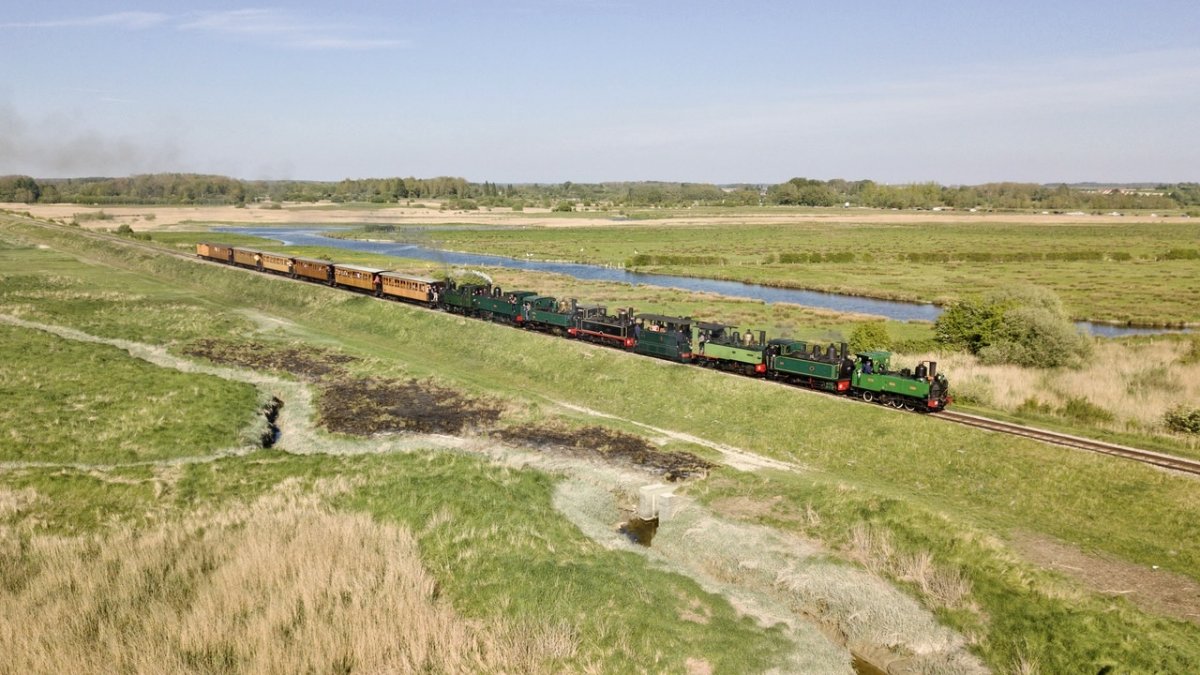
The 12th CFBS Fête de la Vapeur took place over the weekend of the 24 - 26 April. On the morning of the 24th there was a photographers event between Saint-Valery and Noyelles with a selection of locomotives and rolling stock. This was followed in the afternoon with an 'Off' event when the visiting locomotives and members of the CFBS home fleet participating paraded on the quay before travelling individually to Noyelles.They are seen above returning to Saint-Valery Canal coupled together with a train of varnished Somme stock. Further report below.

At Lyon Part-Dieu on 16 March AVE Set 16 waits departure with Train 9742 14.35 to Barcelona Sants.
Renfe gives up Paris paths, tries for TER
According to a report in business newspaper Expansión, Renfe will bid for Lot 2 PLM of Bourgogne-Franche-Comté’s TER services, those over the classic main line between Lyon and Paris. It will be mindful of the fact that SNCF has won seven of the 10 TER contracts awarded so far, including BFC’s Lot 1 Bourgogne-Ouest-Nivernais routes last year. Partners in the bid are KPMG (financial advisor) and Orange (data).
Lot 2 comprises a mix of Mobigo services on the PLM main line: Paris (Gare de Lyon or Bercy) – Dijon – Lyon intercity-style, Dijon – Lyon and Paris – Laroche-Migennes, all two-hourly and overlapping to provide hourly trains at principal stations. Also included is the Laroche-Migennes/Auxerre semi-fast service from Paris via Fontainebleau (Seine Rive-Droit). These services comprise 19% of BFC’s annual train-km. The contract is to be awarded in late 2027 and will run from 9 December 2029 for 10 years.
On 26 March, Renfe announced a call for tenders for up to 40 ‘next-generation’ trainsets capable of running at 350km/h when upgrades to high-speed lines have been completed. These are required to replace ageing trains and expand the fleet to cope with high demand, Renfe said, and would be designed to avoid the problems that have arisen in homologation of the S-106s.
The technical obstacle to authorisation of Talgo Avrils to run between Paris and Lyon is that LGV Sud-Est uses the TVM 300 signalling system, currently being replaced by ERTMS Level 2. So Renfe is faced with the need for certifying operation with two systems, one of which will soon be obsolete. Industry sources report the homologation process as 70% complete but the remaining steps (high-speed dynamic testing and validation by EPSF) are the most demanding. Media reports suggest the test train will be returned to Spain and join the Avril fleet in public service. Will Renfe abandon the quest for authorisation? If it did, the decision could impact on Le Train which plans to use 10 Talgo Avril sets for its proposed high-speed services along France's western coast. However, its 2023 agreement with Talgo was contingent upon Avril gaining approval to run in France.
THE FRENCH RAILWAYS SOCIETY SUMMER RENDEZVOUS
MODEL RAILWAY EXHIBITIONSunday 7th June
Ashtead Peace Memorial Hall, Woodfield Lane, Ashtead, Surrey, KT21 2BE
10am – 4pm
10am – 4pm
Adults £8 Children £2
Working Layouts - Trade Stands
Illustrated Talks - Bring & Buy - Specialist Societies
Working Layouts - Trade Stands
Illustrated Talks - Bring & Buy - Specialist Societies
Refreshments and Free Parking
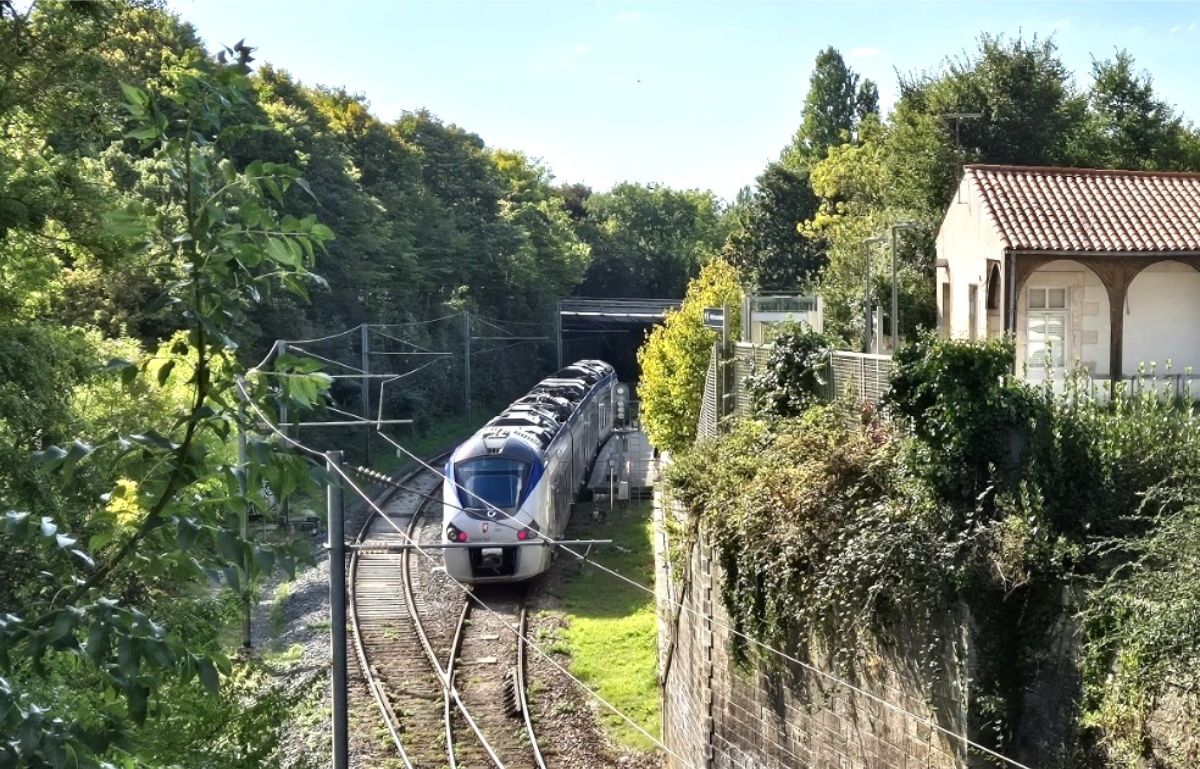
Nouvelle-Aquitaine’s Lot 1 includes the peak-hour local service from La Rochelle Porte Dauphine to Rochefort and Saintes, some continuing to Bordeaux or Angoulême, nine trains daily. On 19 September 2024, Régiolis B 84647/48 enters Porte Dauphine station to form TER 864625 16.48 to Angoulême. The line on the left continues to La Rochelle’s port. Despite its bucolic surroundings, the station here at the end of a 2.5km branch serves the city’s administrative offices, schools and a swimming pool. Photo: John Bamforth.
SNCF wins Poitou-Charente
NA’s first services to be concessioned are local trains on routes in the north of the région across four départements: Charente, Charente-Maritime, Deux-Sèvres and Vienne, extending from Poitiers along the PO main line north to Châtellerault and south to Angoulême and Bordeaux; La Rochelle to Poitiers, Saintes and Bordeaux; and Niort/Angoulême – Saintes – Royan. Together these run 4.6 million train-km (2024 timetable) carrying 5 million passengers annually, 815 trains per week. NA’s call for tenders specified an increase of up to 50% in train-km; SNCF offered a 20% rise, amounting to 22 additional daily trains, together with cost-savings of €112 million over the duration of the contract. Some 400 personnel will transfer to a new SNCF subsidiary (SNCF Voyageurs Terre Atlantique) along with 44 MUs which will continue to be maintained at Saintes Technicentre. The specified 18-month pre-operation period starts in July.
Improvements and changes include: a new service of four direct trains daily from Bordeaux to Royan; together with the existing timetable, this makes Bordeaux – Saintes hourly throughout the day and there will also be more trains between Saintes and La Rochelle. Angoulême – Royan will have a train every 2h at weekends. Four additional A/R will run between Saintes and Niort with better connections to Paris, especially at weekends. Poitiers – Niort – La Rochelle trains will have more cars at peak hours; trains will run every 2h at weekends (Sunday from 12.00). Weekend service at La Rochelle Porte Dauphine will increase, with trains every 2h.
Nouvelle-Aquitaine’s Lot 2 Limousin-Périgord will be tendered this summer for award in January 2028 and start of operations December 2029; Lot 3 Sud-Aquitaine in January 2029 for December 2030 start; and finally Lot 4, services radiating from Bordeaux (l’Étoile de Bordeaux), on dates yet to be determined.

Velvet takes to the rails
PDG Rachel Picard said Velvet’s aim was “to complement existing offers and reinvent the high-speed travel experience. We're coming, we're small, we're different, we're simply going to bring choice, and our only enemy is the car.” Velvet would be offering 10 million seats per year on the Atlantic coast routes where demand outstrips supply. “Currently 15% of would-be passengers abandon their travel plans because they can’t find seats”, she said. Velvet estimates this figure would rise to 25% by 2028 without additional capacity. No other new entrant was ready to serve these routes, Mme Picard noted, hoping to attract Parisians with second homes in the west and southwest, and Paris-based technology businesses which have local offices in the four cities. She cited strong economic growth in the southwest and modal transfer led by high fuel prices as additional reasons for concentrating on these routes.
With Avelias now being delivered and their maintenance assured at Lisea’s Marcheprime site south of Bordeaux, Velvet looks well placed to make a strong start. Other putative new entrants generate noise but little light. Le Train recently secured paths for its proposed services, but it has yet to raise sufficient funding to confirm its 2023 agreement with Talgo for 10 Avril trainsets. In any case, this was contingent upon Avrils gaining approval to run in France, now in doubt (see Renfe story above below). Kevin Speed, which plans high-speed services from Paris to Lille, Strasbourg and Lyon, is also still seeking investors and has postponed its start date to 2030, Photo: Velvet.
MI79s must soldier on
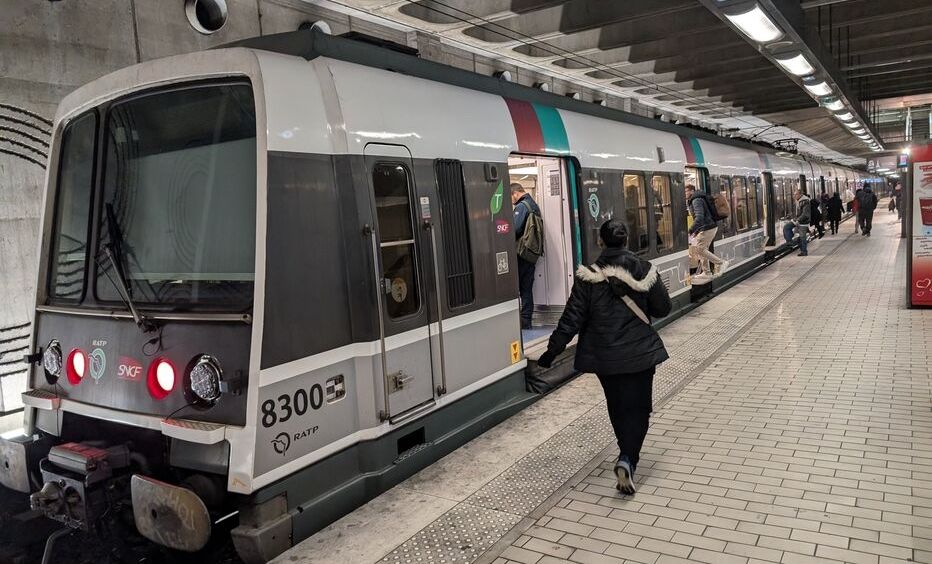
Faced with late-delivery from Alstom/CAF of MI20 trains for RER Line B, Île-de-France Mobilités is to extend the life of ageing MI79 trains (Z 8101/02 - Z 8339/40). A Plan d’intervention starting shortly will see many of the 120 MI79s (dating from 1980-83) refreshed with new seating, upgraded safety equipment and minor work to improve reliability, extending their lifespan by three to five years. RATP’s Massy depot will carry out the programme which will run until 2028. Above left Z 8300 at CDG Airport 1 on 27 January.
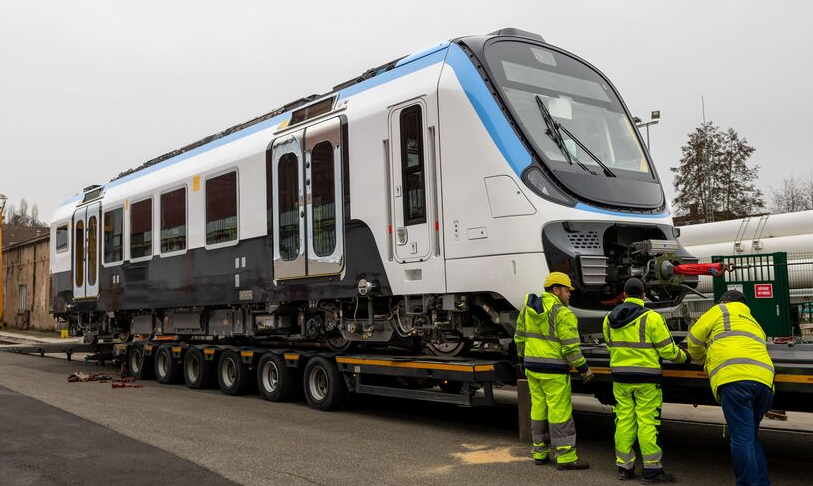
Originally planned for delivery starting in 2025, and then rescheduled for June 2027, the new-generation MI20 trains will not now enter public service until late-2028. Alstom disputes the conclusion of ÎdFM’s expert assessors that they could be further delayed until September 2029 (see November 2025 News). The first cars left CAF Reichshoffen at the end of January, bound for Alstom’s Crespin works for assembly and finishing. Trial running was expected to start in April. Photo: ÎdFM/CAF.
Originally planned for delivery starting in 2025, and then rescheduled for June 2027, the new-generation MI20 trains will not now enter public service until late-2028. Alstom disputes the conclusion of ÎdFM’s expert assessors that they could be further delayed until September 2029 (see November 2025 News). The first cars left CAF Reichshoffen at the end of January, bound for Alstom’s Crespin works for assembly and finishing. Trial running was expected to start in April. Photo: ÎdFM/CAF.
Meanwhile, major works continue for RER B to accommodate the new trains, with sections closed after 22.45 over the coming months. For installation of the NExTEO train control system between Châtelet and Gare du Nord, one of the world’s most heavily-used lines, Line B will be closed south of Gare du Nord between 25 July and 16 August; trains will terminate in the surface platforms. This closure will also see completion of resignalling at Bourg-la-Reine.
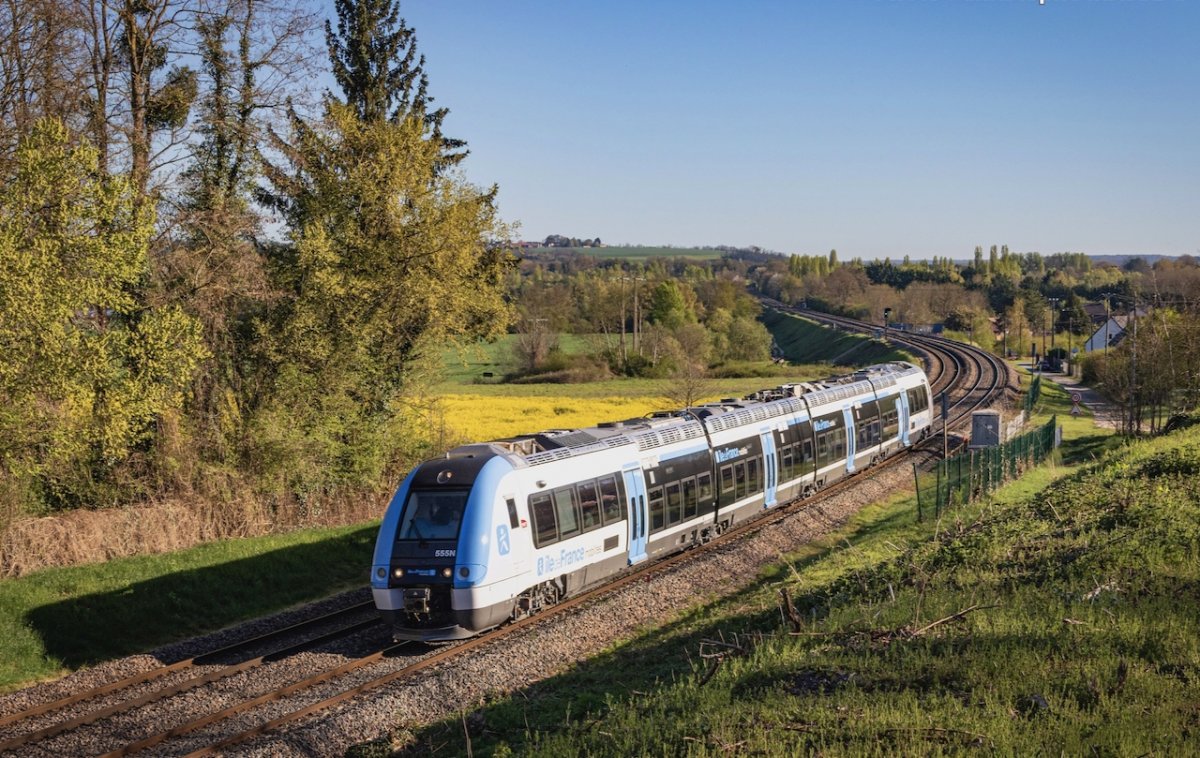
Opter milestone. The 200th MU has been completed under the Opter programme for mid-life renovation of 931 trainsets. Twelve régions and CFL Luxembourg Railways have contracted with SNCF Voyageurs Matériel for upgrading around 40% of their TER fleets, the work being carried out at 10 Technicentres at a cost of €2.3 billion. Stepping up throughput to 100 trains per year will complete the project by 2031.
Back in service on 8 April was 555N (B 82555/56), the first of Île-de-France Mobilités 12 AGC bimodes to receive an Opter facelift, the work being undertaken at Nevers Technicentre at a cost of €55 million. They are used on Transilien’s only unelectrified suburban route, the Line P branch to La Ferté-Milon. ÎdFM approved €6.2 million in 2024 for studies and preliminary work on electrification of the 29km from Trilport, expected to be completed by 2030, though progress has been held up by squabbling with Hauts-de-France région over the €170 million cost. 555N is seen above at Isles-Armentières on the occasion of its presentation to elected officials. Photo: Christophe Masse.
Classique reaches Bordeaux
From 10 April, Classique runs on Fridays, Saturdays and Sundays, outbound from Paris Friday at 14.56 (Train 4025), returning from Bordeaux Saturday at 06.11 (Train 4026) and Sunday at 15.55 (Train 4024).
At around 5h 30, journey time is slower than the best semi-fast timings of the 1960s and way behind the 2h03 achieved over the LGV; trains using the old PO main line are limited to 160km/h. This is reflected in the fares, which range between €10 and €59 (children €5 for any distance). With this further expansion of ultra-low-cost service, intended to consolidate its offer to meet competition from new entrants, SNCF Voyageurs is also well placed to capitalise on fuel shortages caused by war in the Middle East. Coincidentally, an advertising campaign during April for the Paris – Lyon route focused for the first time on both Inoui and Ouigo as Le Choix, a package of travel options geared to all pockets.
SNCF expects 100,000 journeys to be made this year on the Classique Bordeaux trains, and will consider moving to daily operation in summer 2027. Director Jérôme Laffon called Ouigo “our fight to make people abandon their cars by offering the lowest prices”. In an interview with 20 Minutes to mark the arrival of Classique at Bordeaux, Laffon said the Ouigo fleet would increase by 30%, from 38 TGVs to 50 by the start of next year’s summer timetable, “allowing us to serve new destinations and increase existing services”. Each trainset will have an additional nine seats, raising capacity to 653, thus 1,300 passengers on a double rake.


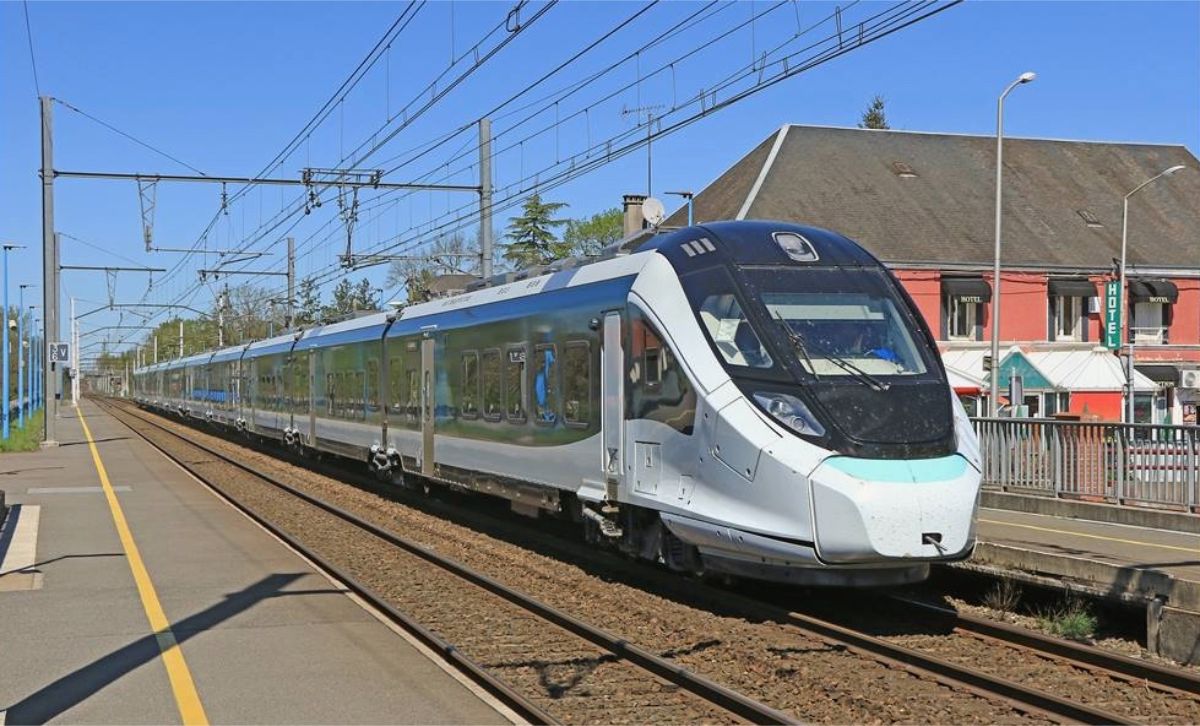
POLT ‘almost there’. Year-long upgrading between Paris and Orléans was completed on 31 March, with 70 track-km renewed between Boisseaux and Les Aubrais at a cost of €133 million. Daytime possessions came to an end on 6 February when the full timetable was restored except for the first and last trains of the day. These remain withdrawn until 31 May whilst the finishing touches are completed on the parallel project to relay 51km of track further south between Lothier and La Souterraine.
During April the pre-series Oxygène trainset Z 26701/702 (PS1) from manufacturer CAF was undergoing 200 km/h endurance testing between Les Aubrais and Vierzon prior to the start of trial running this month with production sets on both the POLT and Paris – Clermont-Ferrand lines, a year before their scheduled entry into public service in April 2027. PS1 is seen passing through Salbris on 9 April.
Photo: Christophe Masse.
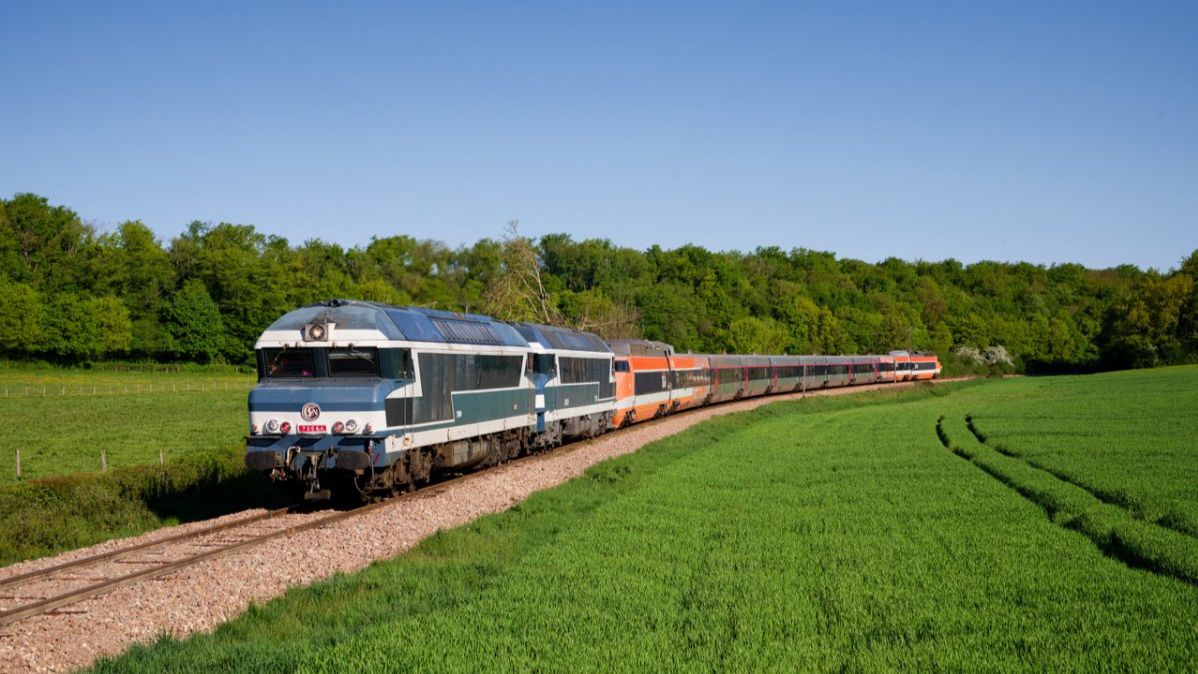
Corbigny swansong? A train never before seen in this Nièvre backwater, on 24 April preserved TGV Set 16 was hauled dead by CC 72084/72064 along the Auxerre – Cercy-la-Tour line en route to the Fête des Chemins de Fer du Creusot, this year celebratingthe 45th anniversary of the 1981 world record run and opening the Paris – Lyon LGV. The stock had spent the night in sidings at Laroche-Migennes before heading for Auxerre, Clamecy and Corbigny and then down the freight-only line to Cercy-la-Tour where it reversed to reach Le Creusot.
The train is seen at Saligny between Clamecy and Corbigny, where the once-daily passenger train was withdrawn last year due to the poor state of the track. Despite Bourgogne-Franche-Comté région’s approval of €3.6 million for upgrading the 33km section, staff at Laroche-Migennes and Clamecy said no work had taken place and doubted passenger trains would ever be restored. Local sources also indicated this would probably be the last through working over the freight section, scheduled for ‘temporary closure’ (according to SNCF Réseau) south of Épiry-Montreuillon from 1 May. Grain trains continue to run northwards from Épiry Photo: Erwan Quintin
Clermont chaos
SNCF acknowledged ‘some disruption’ at the start of the works, when returning Easter travellers overwhelmed the replacement buses. On 6 April, 45 passengers had to be accommodated in Clermont hotels when buses arrived too late to connect with the last IC to Paris, and 15 on the following night. Buses scheduled for the Le Puy route failed to turn up, whilst at some stations passengers were stranded because buses had no space for their cycles. Train service resumed at 16.00 on 17 April, the last day of Zone A school holidays, though other works caused stoppages elsewhere on the lines concerned. Just outside Nîmes, the Cévenol line was closed from 7 until 30 April whilst 400m of retaining wall was strengthened or rebuilt and drainage improved at a cost of €350,000.
Clermont’s SERM took a step forward on 2 April when AURA région rubber-stamped the proposals to be submitted for State approval. This is the most advanced of the région’s six SERMs. It is hoped to implement the first phase of the €1.5 billion project in 2029, when 15min interval service is planned for the north-south Vichy – Clermont – Issoire axis. This will be followed by development of an east-west route Thiers – Clermont – Volvic.
News in brief
At 06.48 on 7 April, TGV 7304 05.56 Dunkerque to Paris Nord running at 160km/h on conventional track hit a low-loader on PN96 at Mazingarbe shortly after departure from Béthune. The driver lost his life and 16 of the 246 passengers were injured. The lorry, part of a military convoy, was carrying an extra-long load, a 45tonne section of Bailey bridge; the driver was taken into custody. He is said to have stopped at the crossing while a TER passed and then moved forward when the barriers lifted but was not able to clear before the TGV struck-in. Visiting the scene, SNCF PDG Jean Castex confirmed that the barriers had been in correct working order. The line between Béthune and Lens was closed until 15 April.
Paris – Troyes electrification entered a new phase on 31 March with reopening of the pont de Sarrail road bridge at La Chapelle-Saint-Luc, four months late due to bad weather. During a year’s closure, the bridge has been raised 70cm to accommodate OHL. Now begins 42 months’ work on Phase 2 which will take the project through to completion in late 2028. Grand Est région has committed a further €14 million of its contribution to the €220 million cost.
In addition to the change mentioned last month allowing them to carry tasers, the 4,000 SNCF and RATP transport police have new powers of stop and search, may prohibit access to trains and stations by ‘undesirable individuals’, and can seize personal belongings on safety grounds. Private security guards working in public transport will receive additional training to broaden their skills. Some 104,700 incidents of theft, violence or fraud were recorded on public transport in 2025, a 2% reduction on the previous year’s figure. In response to a rash of pickpocketing on Metz – Luxembourg trains, onboard police presence was stepped up from 9 April.
All-night lock-in. Shortly before joining the LGV Mediterranée outside Marseille on 30 March, TGV 6180 16.58 Nice to Paris came to a halt at Estaque tunnel near Saint-Louis-Les-Aygalades when a man threw himself in front of the train. The 720 passengers were trapped with no refreshment, poor wifi and little information, according to social media. Eventually, at around 04.00 the train was able to reverse into Marseille Saint-Charles, where some passengers were transferred to hotels; others had to sleep in an empty train. Apologising, SNCF Voyageurs said the investigation, which involved 60 firefighters, had taken about twice as long as usual. The previous week, a Paris – Marseille TGV was delayed 9h 30min by a breakdown.
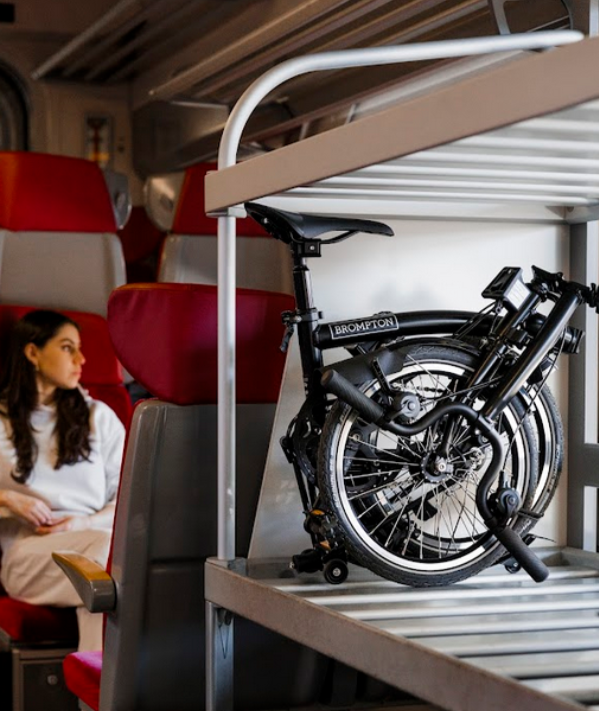
SNCF Voyageurs has partnered with folding-cycle maker Brompton to offer bike hire at €41 per month to facilitate seamless home-train-work journeys. The scheme is available in Nouvelle-Aquitaine, PACA, Pays de la Loire, Bretagne and Grand Est. Photo: SNCF Voyageurs.
Mediterranean corridor freight trains from France to Barcelona port and Catalunya resumed their usual route on 27/28 April after seven weeks’ closure for emergency engineering work of Rubí tunnel in the city’s northern suburbs. One track is open for up to 19 hours daily until the second track is operational at the end of this month.
SNCF Voyageurs and SBB have renewed until 2032 their partnership for operation of TGV Lyria between France and Switzerland and will assess options for extending existing services and introducing new routes. Lyria trains carried 5.7 million passengers in 2025. The summer-only Marseille – Genève service will run this year on Thursdays to Mondays from 16 April to 2 November and daily in July and August.
Grand Est. Savings bank Caisse d’Épargne Grand Est Europe is making a long-term loan of €100 million to the région for financing rail and energy-efficiency projects. Spending will include acquisition of new rolling stock, leasing of infrastructure, electrification studies and support for rural lines.
Biodiversity. An agreement signed on 26 March between SNCF Réseau, the State, the regional environmental authority and other partners will lead to greater recognition of biodiversity in management of 10,000Ha of railway land in Hauts-de-France. The pact consolidates action taken since 2020 to reconcile land-management for safety (tree-cutting, line-of-sight work, weed-killing) with the need to preserve natural habitats and flora. SNCF Réseau will now schedule its annual maintenance programmes with local partners so that sensitive areas or particular species can be targeted for special treatment, work practices adjusted and feedback shared.
Saint-Pierre-des-Corps. A wheel-profiling machine was commissioned at the Technicentre on 1 April. Centre-Val de Loire région has financed the €9 million cost to cut turnround times of MUs undergoing their 180,000km reprofiling. Previously, trains had to be sent elsewhere for the work to be carried out, taking at least three days. Now, each axle can be treated in 2h.
Getlink’s biggest shareholder Eiffage has increased its holding to 29.4%, just below the 30% threshold at which it would be required to make a bid for the company. Second-biggest shareholder Italian group Mundy’s has also raised its holding by 3.5% to 19%.
The 10 April implementation of the European Entry/Exit System was not met due to further delay with the technology to collate and process biometric data. Passports of Le Shuttle and Eurostar passengers are still being hand-stamped; only lorry drivers, coach passengers and ferry classic passengers are currently subject to EES formalities.
Despite pausing its hydrogen traction development (see January News), Alstom has acquired the rail hydrogen fuel cell activities of Cummins, providing engineering, product and support capabilities for its existing hydrogen trains.
Opening the new season on 4 April, PDG of the Puy du Fou theme park Nicolas de Villiers pressed for a start on rebuilding the 32km line from Cholet to Les Herbiers which he suggested could reopen in 2029. The proposed seven A/R daily would bring a 10% increase in visitors, he said, mainly day-trippers from Paris, as well as catering for the travel needs of locals. The State has promised €20 million towards the estimated €50 million cost. Pays de la Loire région is carrying out feasibility studies.
Dives-Cabourg. Seasonal service from Trouville-Deauville resumed on 26 March and will run until 28 September. Outside July and August trains run mainly at weekends. There is also a train to the resort on Thursday and Friday evenings, returning at 05.12 on Monday mornings, intended for weekenders from Paris. Six A/R run daily during the summer months. The line carried 43,000 passengers in 2025
Cycle changes. The nationally-mandated provision of cycle spaces in TER trains has been abolished, leaving it to the régions to decide how much space to provide based on local conditions: a simplification, the government said. Previously 2% of the seating space in any MU had to be given up to cycles, with a minimum of four and maximum of eight spaces. Cycle groups lament removal of the legal minimum, ‘a national safeguard’ for cyclists’ rights, fearing that some régions will skimp on space and more will require prior reservation.
President Macron inaugurated work on Imerys’ Échassières lithium mine in Allier département on 22 April, one of 150 projects to be fast-tracked under a new national industrial strategy. From 2030, the world’s fourth-largest deposit will produce 1.5 million tonnes of mica per year for processing into 34,000 tonnes of lithium, sufficient for 750,000 electric-vehicle batteries. Raw material will be removed by rail, necessitating upgrade and resignalling of the line between Gannat and Montluçon at a cost of €80 million. Details of the upgrade have yet to be announced.
Guingamp – Carhaix was closed between 13 and 24 April for track maintenance work. All trains were replaced by buses except for one Friday evening return.
Some staff at Lyon went on strike on 17 and 23 April in protest at SNCF Voyageurs’ plans for extending driver-only operation to Mâcon – Lyon – Valence TERs. Some Lyon-area services already run without a contrôleur, their ticket checks carried out before boarding or by mobile patrols. Trades unions oppose the move which they say will lead to ‘further deterioration of onboard safety and security’.
SNCF Voyageurs Italia says it will run its first trains in September 2027, seven A/R Turin – Naples and two Turin – Venice, quickly adding two more on each route. Presenting Project Allegro in Rome on 16 April, PDG Christophe Fanichet said that fares would be 15 to 20% lower than those of incumbents Trenitalia and Italo, possible because of the high capacity of TGV M trainsets. Some 400 personnel will be recruited.
Winter draws on. As well as its Paris – Bourg-Saint-Maurice night train, Travelski will this year run a service from Amsterdam, Rotterdam, Antwerp and Brussels to Tarantaise valley resorts, Pegasus Trains again providing rolling stock; both trains will be electrically-hauled throughout. Travelski is looking at including a first-class option in the Amsterdam train, which will offer around 400 berths against 660 from Paris. Booking opened on 20 April for the trains which run on 15 weekends from mid-December to the end of March.
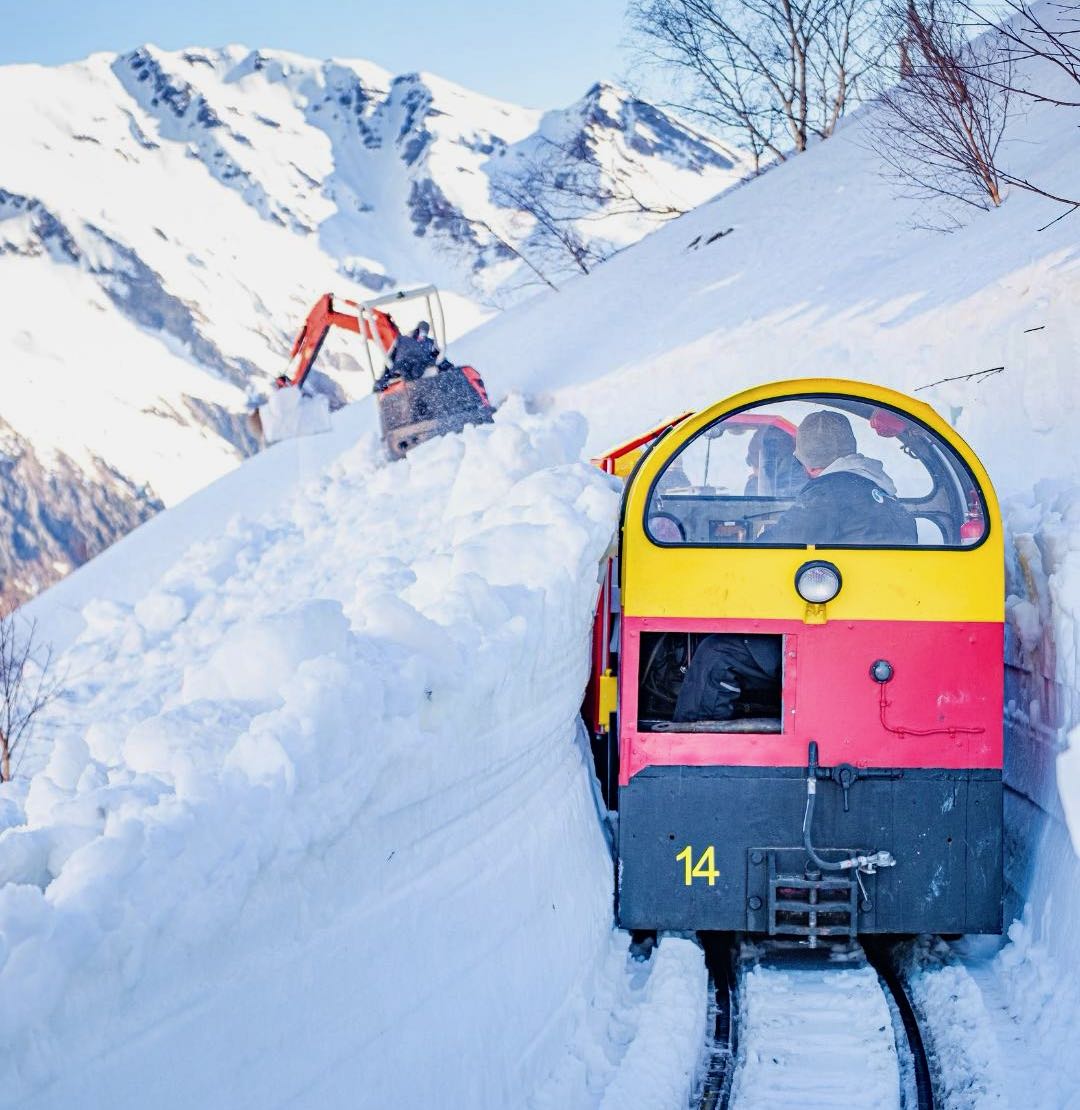
Clearing the route of the Petit train d’Artouste at 2,000m altitude was a major challenge after this winter’s particularly heavy snowfalls in the Pyrénées. Staff worked throughout April to clear snow several metres deep ready for the 8 May start of service. Photo: Artouste.

Veynes. Platform road Voie C, closed for several months due to a track defect, is being relaid. Sleepers, rail and ballast are being replaced over 780m at a cost of €1.3 million shared between the State, Région Sud PACA and SNCF Réseau. The platform, the station’s longest, should be reopened on 5 June. On 25 April 2025, TER 17368 10.47 Briançon – Valence – Romans enters Voie C at Veynes. Photo: Pierre Julien.
Lisea has achieved financial closure for funding its high-speed train maintenance depot under construction at Marcheprime south of Bordeaux. €266 million has been raised through a mix of equity and long-term debt.
A two-month upgrade of the Saumur – Thouars line was completed at the end of April. SNCF Réseau spent €6 million renewing sleepers on the Vienne viaduct outside Saumur, and at Nantilly and Montreuil-Bellay, plus reballasting, points fettling and drainage work at several other locations.
In a blow for supporters of reopening the Agen – Auch line, local grain companies have refused to consider transferring their traffic to rail. Occitanie transport vice-president Jean-Luc Gibelin canvassed agribusinesses in Gers and Lot-et-Garonne but “none is ready to put produce back on the rails, not even a gram”.
ÎdF région has voted €34 million towards studies of Line Y, the split of RER Line C to improve service on the southern branches to Saint-Martin d’Étampes and Dourdan-la-Forêt (see January News). A further €15 million has been provided by the State. As well as planning for the separation, the funds will cover tendering for the new fleet of 55 EMUs.
Paris – Berlin. European Sleeper’s Berlin departure on 12 April reached Brussels 7h late the following morning after the loco broke down; Paris passengers were conveyed to their destination by bus as no crew was available passed to work in France. The train was cancelled between Paris and Brussels three times in a row.
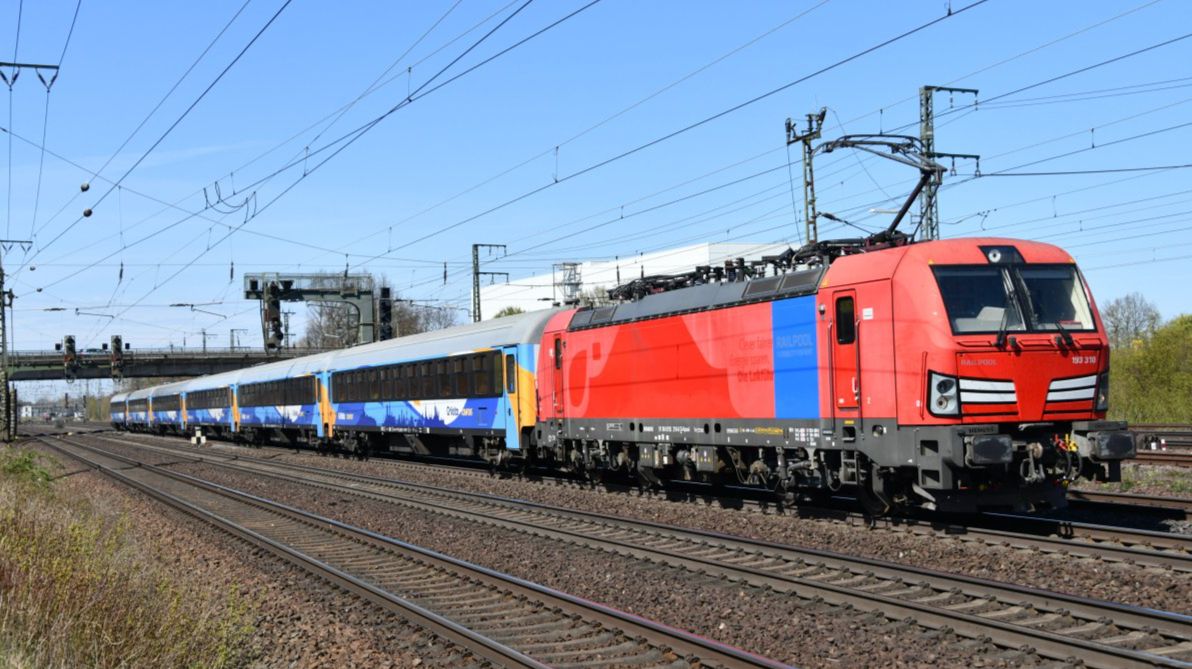
Dutch start-up GoVolta, which launched thrice-weekly day trains from Amsterdam to Berlin and Hamburg in March, is seeking regulatory approval for an Amsterdam – Paris service to start in December with fares from €50. The company has 13 refurbished 1987-vintage I10 coaches ex-SNCB; Keolis manages train operations and provides drivers for motive power hired-in from Train Charter Services.
Above. Railpool-leased Vectron (ex-DB) 193 310 is seen passing through Wunstorf (near Hannover) on 9 April with Train GV327, GoVolta's Amsterdam – Berlin service. Photo: Didier Delattre.
Transport bill voted through
During three days of debate in mid April, the Senate passed the main provisions of the bill on transport finance (the so-called framework law or loi-cadre) which was approved on 28 April. This establishes the basis for a future law on national transport finance. As expected, it would commit infrastructure spending for 10-year periods (reviewed after five years) using revenue hypothecated from the profits of renegotiated motorway concessions. With a maintenance backlog estimated at €3 billion a year, resources are to be directed at regeneration of ageing infrastructure rather than new projects. €2.5 billion annually from motorway tolls will be reserved for financing modernisation of railways, roads, inland waterways and ports.
Transport minister Philippe Tabarot said the law would “finally give our country a sustainable infrastructure funding model”. The government would sign "in the coming weeks" an updated performance contract with SNCF Réseau he said, which includes "increased investment from €3 billion to €4.5 billion per year from 2028 for regeneration and modernisation of the network". An amendment was passed to ensure provisions applied to both the ‘structural network’ and the 5,000km of dessertes fines, the minor routes so in need of modernisation. SNCF Réseau is already planning to accelerate its pace of renovations from 750km per year to 1,000km.
The framework endorses the main conclusions of the Ambition France Transports commission; however observers agree that drafting the new law and getting parliamentary approval before next year’s presidential elections will be a challenge. In addition, there remains the question of finding resources to bridge the four-year investment gap before money starts to flow from motorway concessions in 2031, a lacuna which the new law must fill.
In other provisions, discussions focussed on passengers’ rights. Senators decided that SNCF must offer competitors’ tickets on SNCF Connect from 2028, a move it had strongly opposed. PDG Jean Castex was said to have tried to convince senators that the measure would jeopardise SNCF's remit to be profitable, as demanded by its shareholder (the State). Competitors were delighted. They had pressed for the change to help them build market and public awareness, while passengers would benefit from the offer of alternative services. But independent sales platforms such as Trainline fear it would lead to further entrenchment of SNCF Connect’s dominance. Île-de-France Mobilités will retain its monopoly on ticket sales in the greater Paris area.
Incentive schemes would be drafted to encourage new entrants to participate in regional development by financing new services at less-popular stations, and to discourage ‘cherry-picking’. A further clause aims to strengthen passengers’ rights on journeys involving multiple operators, with guaranteed connections in the event of disruption.
Also agreed after heated debate was provision for public transport fares to be raised each year in line with inflation. The minister pointed out that fares were set locally and there was “no plan…to double public transport fares” as opponents had feared. Local authorities would now have the power to index fares but would be free to disregard the provision, though the government hoped to reduce the current subsidies of as much as 83%. There would also be no general extension of fares-free transport, a policy the minister opposed whilst conceding that it was appropriate in certain special circumstances.
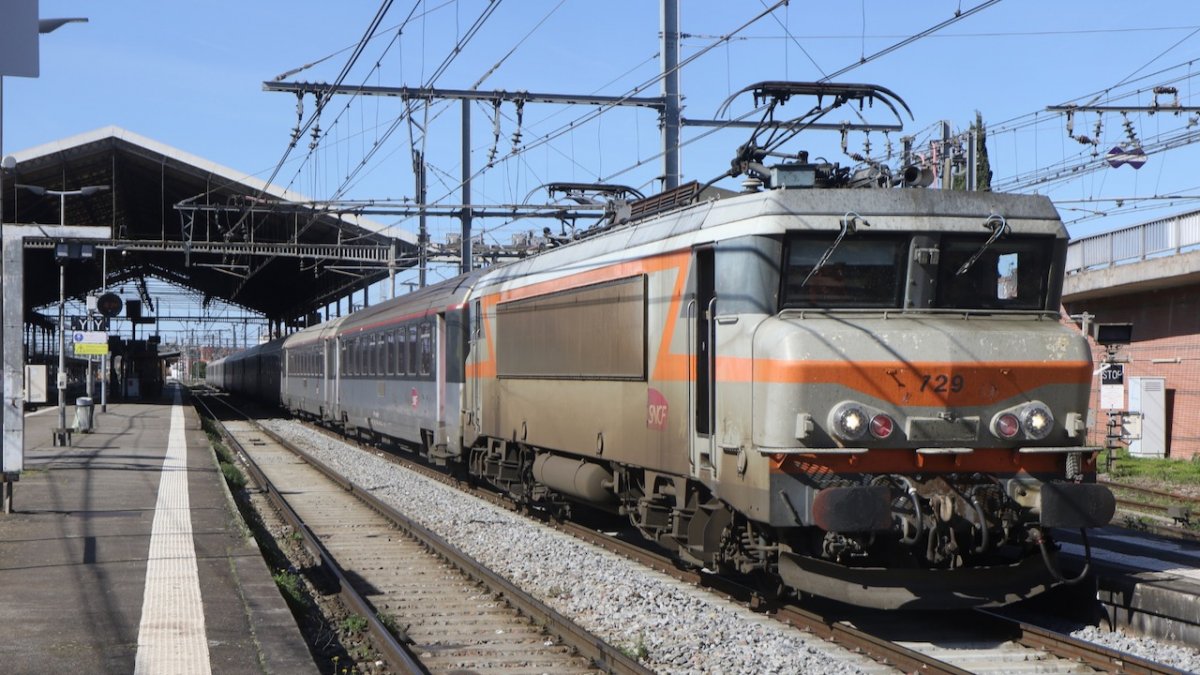
Easter engineering work between Bordeaux and Langon saw Bordeaux – Marseille Intercités services only running between Toulouse and Marseille, with express buses providing the connection from Bordeaux. On Saturday 4 April, BB 7293 waits to depart from Toulouse at 16.44 with IC 4663 to Marseille Saint-Charles. The bus ‘connection’ from Bordeaux was not scheduled to arrive until 17.10, those passengers having to continue by road to Marseille. Photo: Georges Turpin.
State-aid rules updated
New regulations came into force on 30 March governing how EU member states grant aid for rail activities, updating rules set out in 2008. The Land & Multimodal Transport (LMT) guidelines are supplemented by a State Aid Transport Block Exemption Regulation (TBER) which relieves the need for EC approval for a wide range of standard investment or aid schemes. Other changes reflect progress with digitalisation, cross-border interoperability and competition from other modes, and make provision for access to finance for small companies and new entrants seeking to acquire rolling stock.
The LMT guidelines clarify and consolidate the conditions under which member states can grant aid for:
● construction and upgrading of facilities;
● infrastructure investment linked to service facilities;
● launch of new commercial freight services;
● compensation for public service obligations in the freight sector;
● measures reducing external costs of transport;
● interoperability and cross-border operations, including digital and safety-related upgrades.
The measures will simplify the grants process for all but the largest projects. Routine activities covered by TBER can proceed unimpeded, while larger or more complex schemes will still require notification and EC approval.
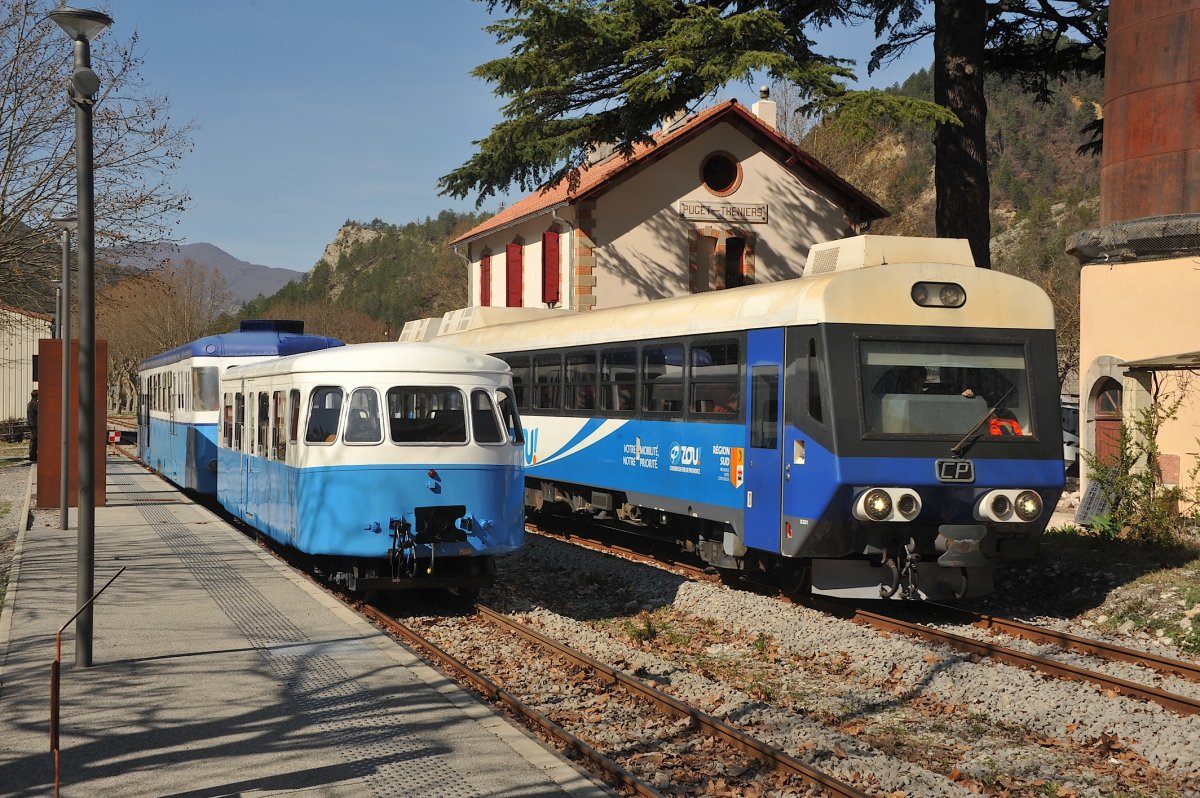
Over the last winter GECP (Groupe d’Etude pour les Chemins de fer de Provence) have restored to full working order railcar trailer Billard RL 3 from Chemins de fer de Provence. This typical car was delivered in 1959 and used in its original form to raise the capacity of CP railcars until 1988, then it was converted as a parcel van and used until 2010. Today RL 3 remains the last of the seven Billard trailers used by CP. On 24th March it is seen crossing Soulé X 351 DMU at Puget-Théniers, just before its first trial run to Annot with Renault ABH railcar ZZ 6. Photo: José Banaudo
CFBS Fête de la Vapeur
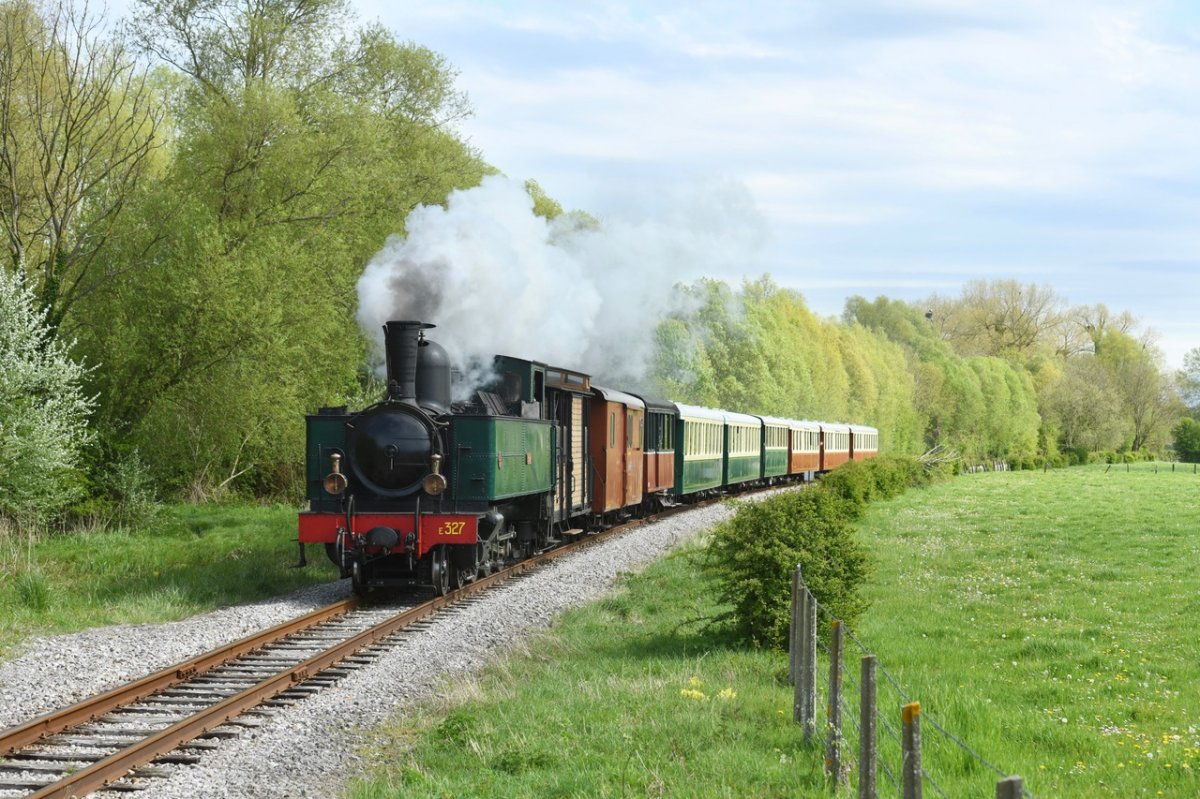
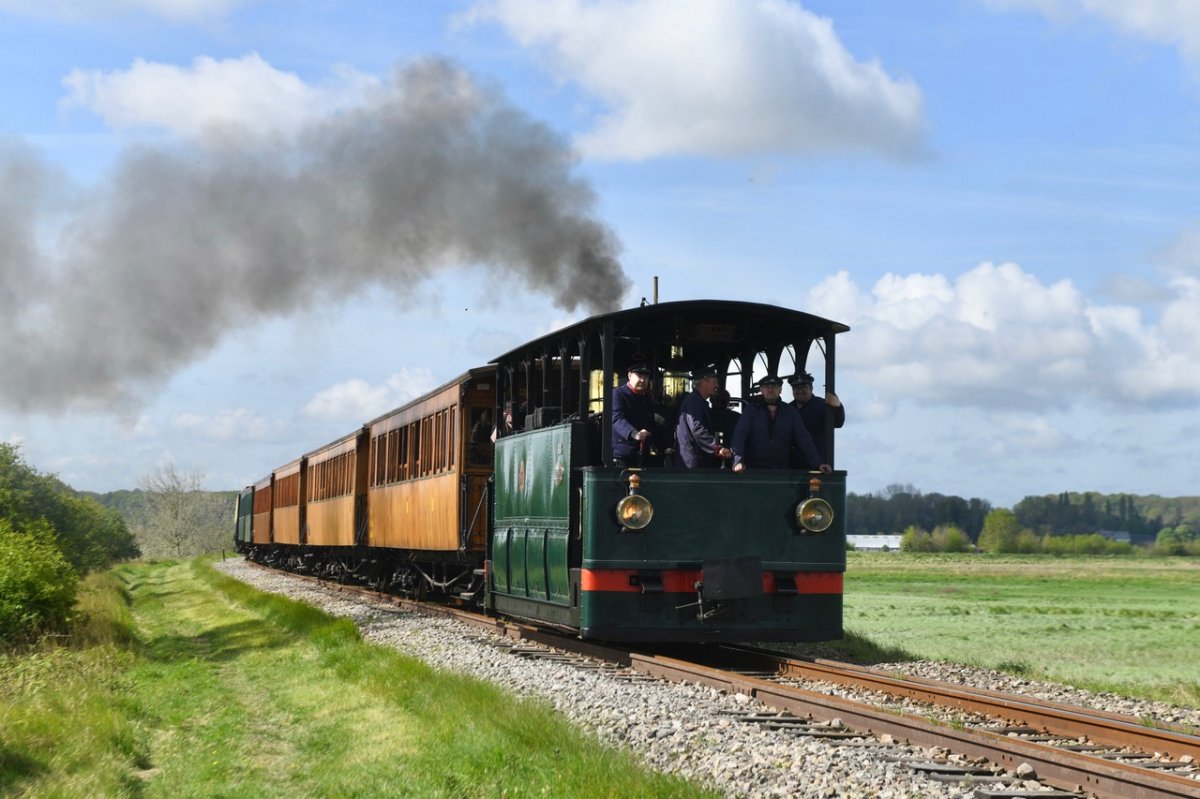
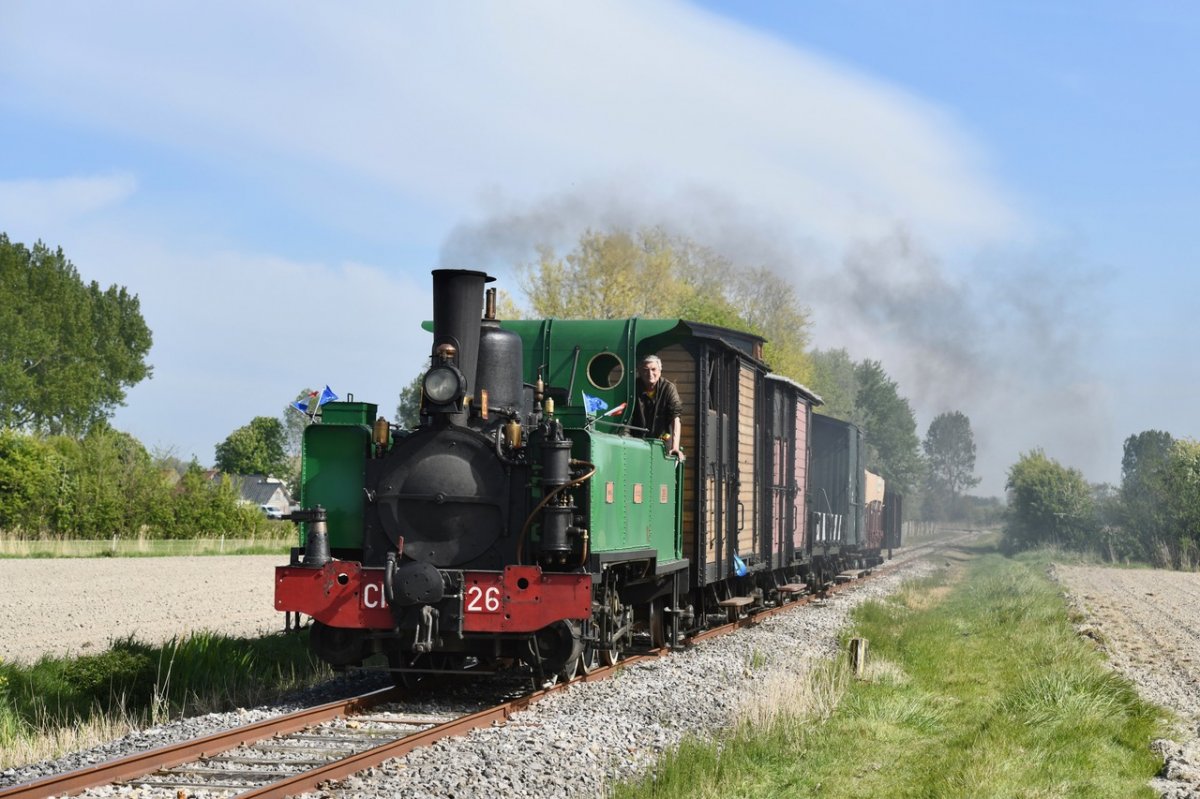
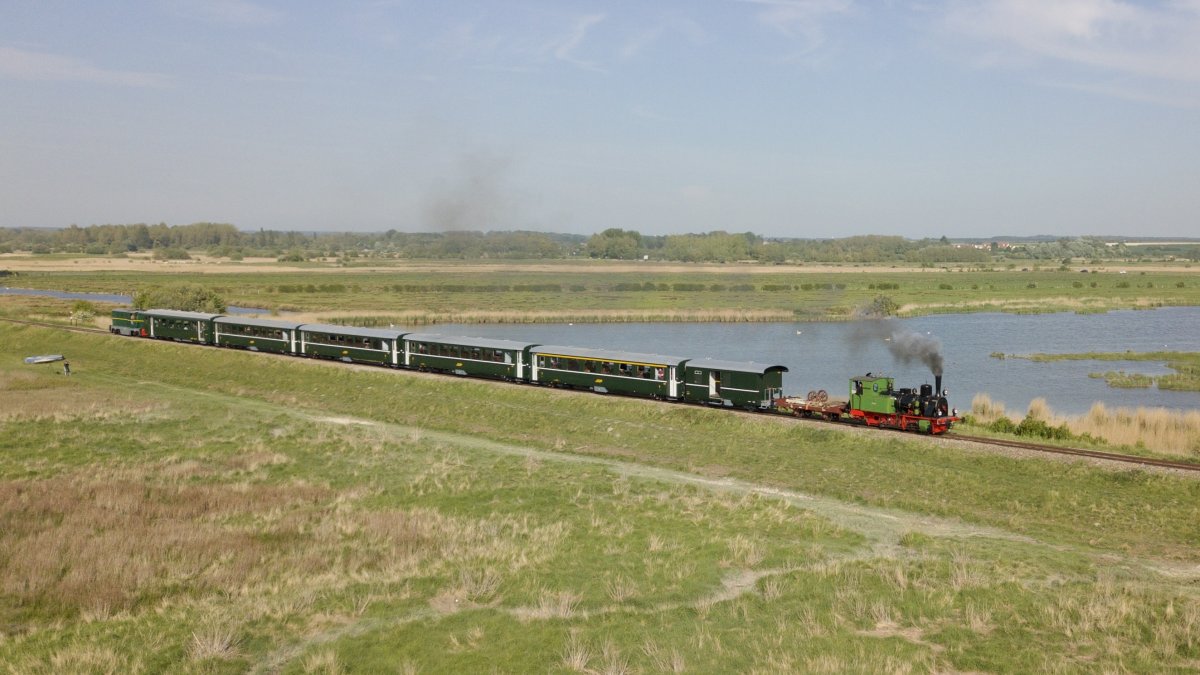
CFBS hosted five visiting locomotives for their Fête. In clockwise order, GECP's Réseau Breton E 327, Musée du Tram Vicinal HL 303, Landquart-Davos G 3/4 14 ‘Madlaina’, and Chemin de fer Historique de la Voie Sacrée Corpet 'La Suzanne', along with CFBS's Haine-Saint-Pierre 15, Pinguely 101, Cail 2 and Buffaud-Robatel 3714. An hourly service was operated between Le Crotoy and Cayeux with trains being re-engined at Noyelles. ‘Suzanne’ operated a demonstration freight or MV between Cayeux and Lanchères. Between Noyelles and Saint-Valery services were augmented by a former RhB set operated either by a CFBS diesel or Henschel 'Christiane' from Chemin de Fer Touristique du Rhin, providing the unique combination of a standard gauge locomotive hauling metre- gauge stock (bottom photo). Apart from some slight delays on Sunday afternoon the event ran smoothly throughout and was a tribute to those involved, who were mainly volunteers.
Three main line rail charters were scheduled to visit the event. On Saturday the MFPN train from Paris was cancelled due to locomotive failure. The Pacific Vapeur Club train left Sotteville hauled by BB 67611/67558. BB 67611 was declared a failure at Motteville and the train departed behind BB 67558 with BB 67611 dead in tow. After a couple of km, BB 67558 failed as well. The train was then propelled 35km by Captrain 420730 Le Havre – Somain freight hauled by BB 27014 to Montérolier-Buchy where BB 67514/593 took over, arriving at Noyelles four and a half hours late at 16.45. Sunday’s AAATV's special from Les Aubrais to Boulogne ran to time, producing CC 72074 instead of A1A A1A 68540, a return to the area of a class that was familiar 25 years ago.

Lourdes. The Pic du Jer funicular reopened on 27 March after the second phase of a major upgrade. Cars run every 20min to the upper terminal at 888m, close to the summit with its spectacular views.
Langlade. The station building on the PLM line from Nîmes to Le Vigan, closed in 1969, is being restored as a restaurant after 30 years’ use as a library. A 6km voie verte follows the old alignment from here to Calvisson.
At Pau, the funicular that carries 6,000 passengers a day between the town and the station is undergoing its 10-year inspection, cable replacement and other work at a cost of €413,000; reopening 3 July.
Villeneuve-sur-Lot. Construction of a voie verte over the former line to Penne resumed last month after a delay due to residents’ objections. The project had been granted public utility last September.
Train Rouge. Community-owned Train du Pays Cathare et du Fenouillèdes has begun the process of taking ownership from SNCF of its 62km route between Rivesaltes and Axat. Meanwhile, the local parcels service is it be revived, with electric cargo bikes undertaking delivery to individual addresses. Other moves include fitting solar panels between the rails if SNCF’s experiment proves successful, and possible use of the line as a testbed for EcoTrain.
La Vapeur du Trieux will operate this year between Sunday 14 June and Tuesday 15 September. During July and August it will operate Sunday to Thursday and Sunday to Tuesday on other dates.
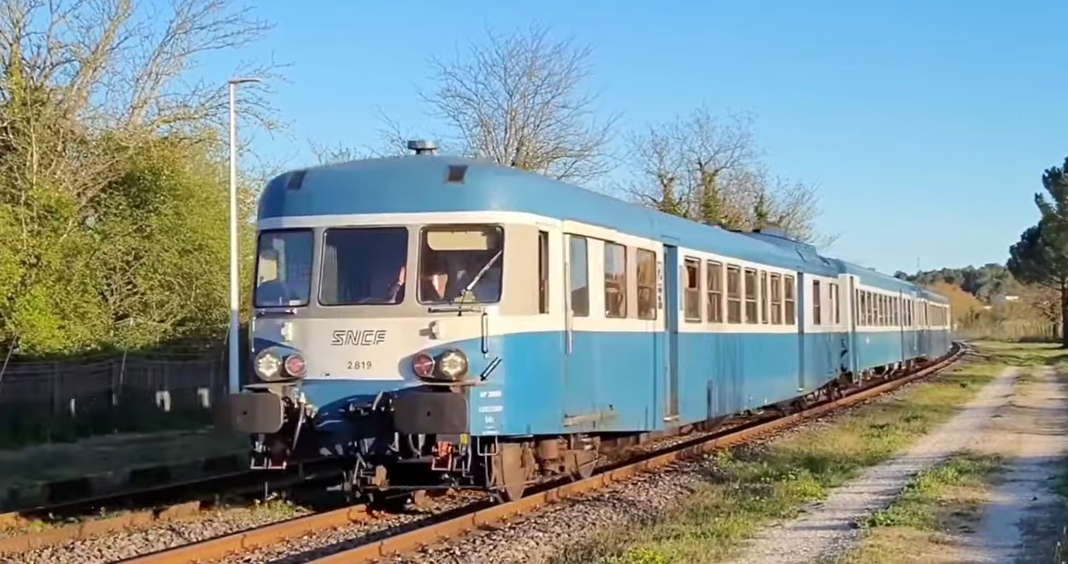


This years Fête des traditions maritimes at Sète attracted two charter trains of preserved rolling stock on the 4 April. From Langogne AP2800 headed down the ligne des Cévennes with their Train Bleu de Sud made up of XABD 2819 + XRABD 6091 + XABD 2914.
From Toulouse Le Train historique de Toulouse operated their train of historic rolling stock, steam heated and hauled by BB 7338. Seen above, awaiting departure from Toulouse, looking resplendent following a complete repaint last year. It is now carrying 'Toulouse' nameplates, replicas of those originally borne by CC 6524. As a preserved locomotive it is now plated at 120km/h while its scruffier SNCF classmates can still run at a maximum of 160km/h Photo: Georges Turpin.
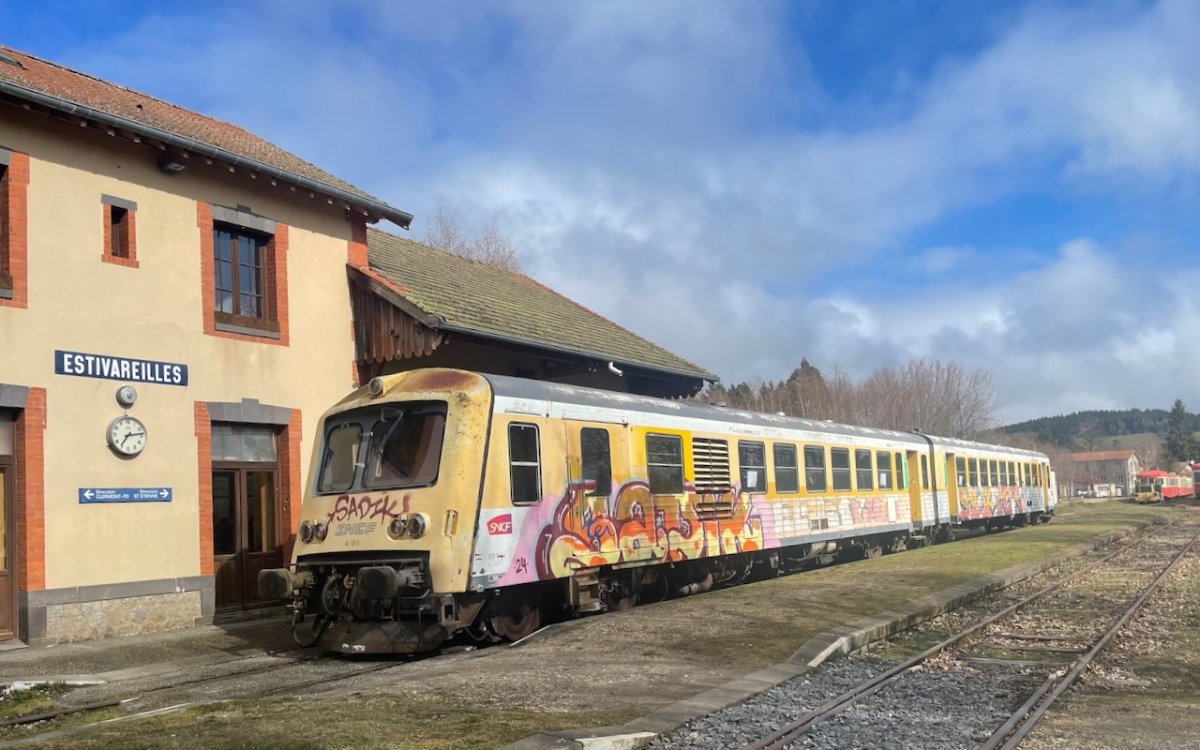
The transfer of modified Caravelle X4786 from Les Laumes to Chemin de fer du Haut Forez at Estivareilles has now been completed (see April News). The final leg from Pont-de-Dore took place on 13 March hauled by CFF's BB 63705. The autorail is reported to be in poor condition needing a complete mechanical overhaul, restoration of the interior and a repaint. Photo: Roger Allen.
Urban rail
Election news
Municipal elections in mid-March brought new administrations to several cities including Lyon, Nice and Bordeaux, heralding policy changes and alterations to metro and tramway expansion plans. Paris, Lille and Toulouse remained in the same hands.
In Nice, the new métropole president Eric Ciotti has talked of resurrecting the €4 billion Nice – Monaco metro (30km, 12 stations), a project shelved by the previous administration and described as ‘not realistic’ and ‘unsustainable’ financially and technically.
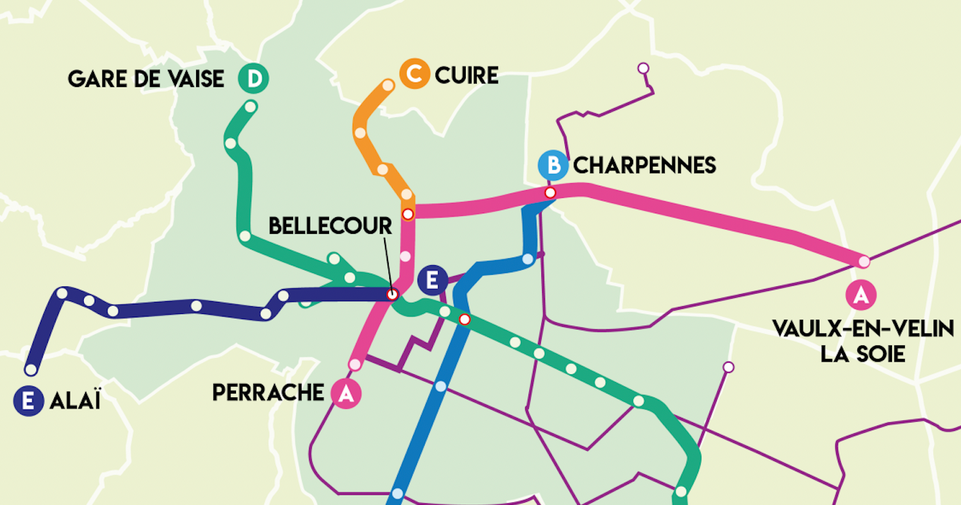
In Lyon the new administration headed by Véronique Sarselli immediately fulfilled a manifesto commitment by announcing abandonment of the proposed TEOL east-west tramway, described as ‘of limited use and not serving major centres of activity’. In its place, metro Line E, shelved by the previous council in 2022, is to be revived. Initially, this would link Tassin Alaï and Bellecour, 8km (6.6km in tunnel), opening by 2035 at a cost of €1.2 billion, with an eastwards extension to Saint-Exupéry airport planned for 2040. T8 would go ahead though with some modifications to the route in the Saint-Priest area. Metro lines B and D would be equipped with platform screen doors within three years and renovation or replacement of escalators and lifts would be accelerated. This is a major bugbear; some have been out of service for a year or more. In February 46% of escalators were reported out-of-use, and 21% of lifts
The new maire of Paris Emmanuel Grégoire promised to cut city hall's fleet of chauffeur-driven cars, saying he and other senior officials would use public transport whenever possible. He wants to try 24-hour operation on the three automated metro lines M1, M4 and M14, as well as opening-up more of the disused Petite Ceinture to walkers and cyclists. In Montpellier, the re-elected maire’s plan to improve safety on the streets includes 100 more officers for the transport police.
Re-elected in Marseille, Benoît Payan’s priority will be revision of the bus network to ease over-crowding and cut poorly-used routes. The disputed Catalans extension of T2 will probably be deferred in favour of trams serving the ‘great forgotten zones’ as he put it, routes north to Saint-Jerôme and east to La Barasse. Also planned is a southwards extension to La Rouvière of T3 which reached La Gaye in January.
Opposite. One of the latest batch of Alstom Citadis 403 trams that meets German BOStrab standards waits beside Kehl Rathaus at the end of Line D from Strasbourg on 10 December 2025. Following a framework agreement in April 2023 delivery of the initial order of 12 started in June 2025, and a further 27 have been ordered to enable the ABB Eurotrams dating from the 1990s to be withdrawn.
On 27 April, the new métropole council in Bordeaux abandoned studies for metro Line 1 (see May 2025 News), along with a proposed cross-river cable car. One tram project is being considered, construction of a short link across the pont Chaban-Delmas, the lifting bridge opened in 2013 and built to accommodate tram lines. Two options are proposed, Cité du Vin to Galin or Cenon Gare. A second tram crossing of the Garonne would shorten journey times for some passengers and relieve pressure at the Quinconces and Porte de Bourgogne interchanges. The new maire Thomas Cazenave criticised the chaotic introduction last December of routes E and F, saying he would concentrate on development of the SERM, improving reliability and developing the next generation of trams.
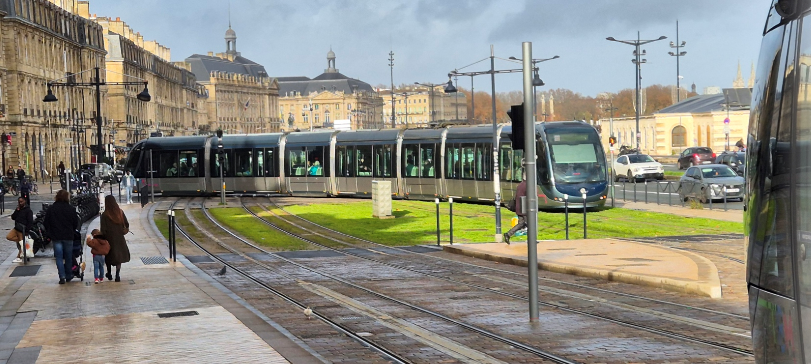
Above. A Route F car from the airport blocks all lines at Porte de Bourgogne as it crosses from west to south en route to Gare Saint-Jean and Bègles. The new route structure puts heavy pressure on the narrow platforms here, where thousands of passengers change each day.
Strasbourg elected Catherine Trautmann who was maire in the 1990s when trams were reintroduced to the city. She intends to ‘prepare the network of tomorrow’, reviving the Tramway Nord project to Schiltigheim and Bischheim and the associated Tram des Brasseries north-south route, as well as the planned Route C extension 2.8km to Neuhof Stockfeld. Her ‘move freely in Strasbourg’ policy would see introduction of 5min interval service on all routes and 10min on Sundays. Mme Trautmann also supports the Ambition 360° project for expansion and redevelopment of Strasbourg Gare to accommodate more trains on the SERM network.

On 13 March, a train ran for the first time in automated mode on Line 18 of Grand Paris Express, reaching a speed of 110km/h, ‘two important technical milestones’ Société des Grands Projets said. Line 18 is scheduled to open between Passy-Palaiseau and Christ de Saclay in October, the first section of the 175km GPE network to enter service. On Line 15, construction has started on the station at Bondy where there will be interchange with RER Line E and T4. This section of the 75km circular route opens in 2030. Photo: Société des Grands Projets.
M14 is now the busiest metro line in Paris, averaging 820,000 passengers daily during 2025. A big increase is expected when GPE Line 15 Sud opens in a year’s time, with Saint-Denis – Pleyel forecast to rival Châtelet as the metro’s busiest interchange. The C1 cable car line linking metro Line 8 at Créteil-Pointe du Lac with Villeneuve-Saint-Georges, opened on 13 December, carried its millionth passenger on 30 March. Halving the travel time to reach the metro has been a big draw for local residents.
M14 is now the busiest metro line in Paris, averaging 820,000 passengers daily during 2025. A big increase is expected when GPE Line 15 Sud opens in a year’s time, with Saint-Denis – Pleyel forecast to rival Châtelet as the metro’s busiest interchange. The C1 cable car line linking metro Line 8 at Créteil-Pointe du Lac with Villeneuve-Saint-Georges, opened on 13 December, carried its millionth passenger on 30 March. Halving the travel time to reach the metro has been a big draw for local residents.
Diversion of utilities is nearing completion at Tours in preparation for construction of T2. The line runs west to southeast from Prieuré-Saint-Cosme in La Riche to Papoterie in Chambray-lès-Tours, 12.5km, 22 stops, interchange with T1 on the common section in the city centre at Liberté-Charcot and Verdun. CAF is building 19 cars for the line which opens in 2028.
On the 1.2km extension of Genève’s T17 in Annemasse, the last rails welded in mid-March and trial running will begin shortly. There are three new stops at Place Deffaugt, Barbusse and Perrier-Aubrac (park-and-ride) on the €41 million extension which opens in September.
On the 1.2km extension of Genève’s T17 in Annemasse, the last rails welded in mid-March and trial running will begin shortly. There are three new stops at Place Deffaugt, Barbusse and Perrier-Aubrac (park-and-ride) on the €41 million extension which opens in September.

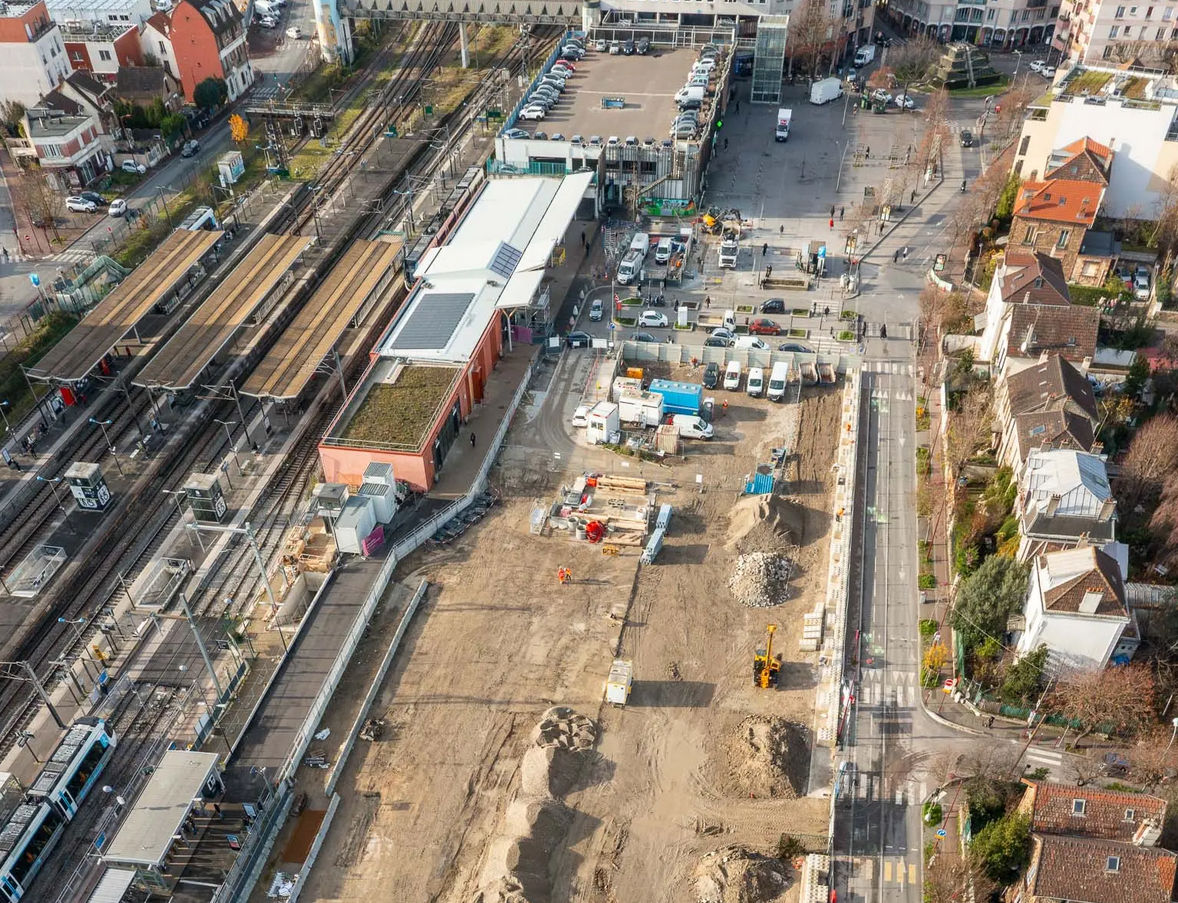
Boring of the tunnel for François-Verdier station on Toulouse Line C was completed on 3 April. At 45m depth, Line C here passes beneath Line B with which it will interchange. One of the five boring machines finished its work at the end of last year; the remaining four have 8.5km of tunnel to complete and work has been accelerated to recoup time lost due to delays in evacuation of spoil. The first of nine additional cars on order from Alstom was delivered on 10 March (Top left, Photo: Tisseo), part of an order for 22 placed jointly with Brest and Besançon. Six of them are fitted with luggage racks and destined for the revised Aéroport Express lineopening at the end of this year. The other three will enter service on T1 in September. Garossos maintenance depot has been extended to accommodate an additional 12 cars, bringing capacity to 38.
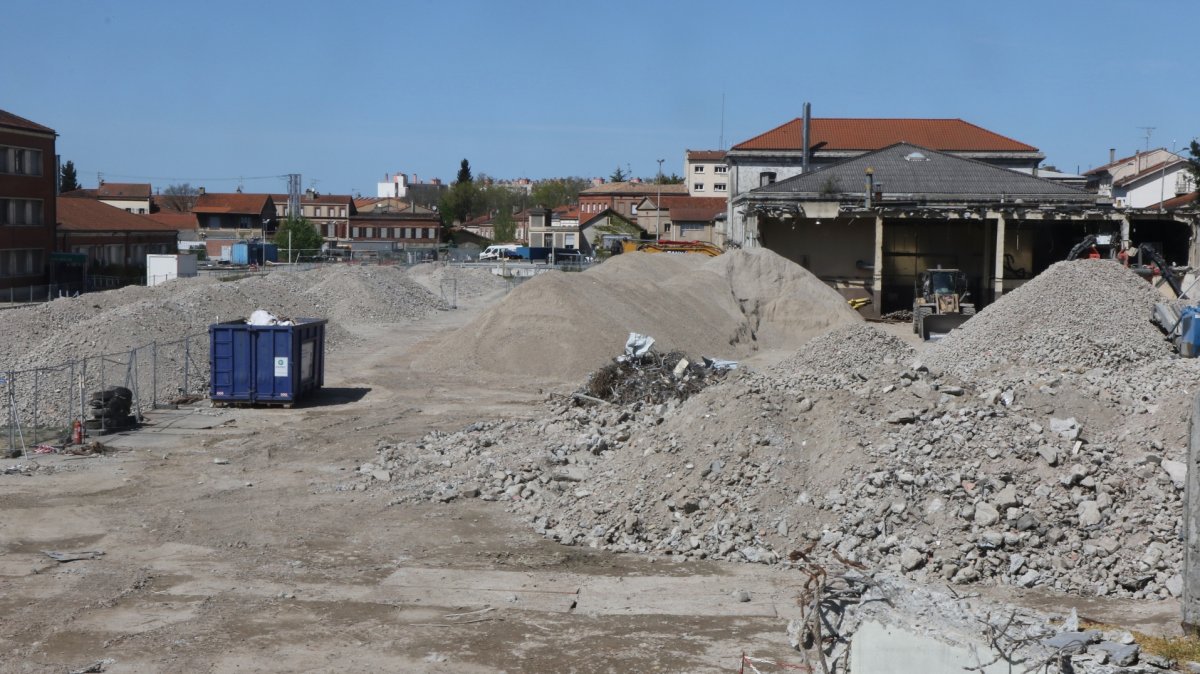
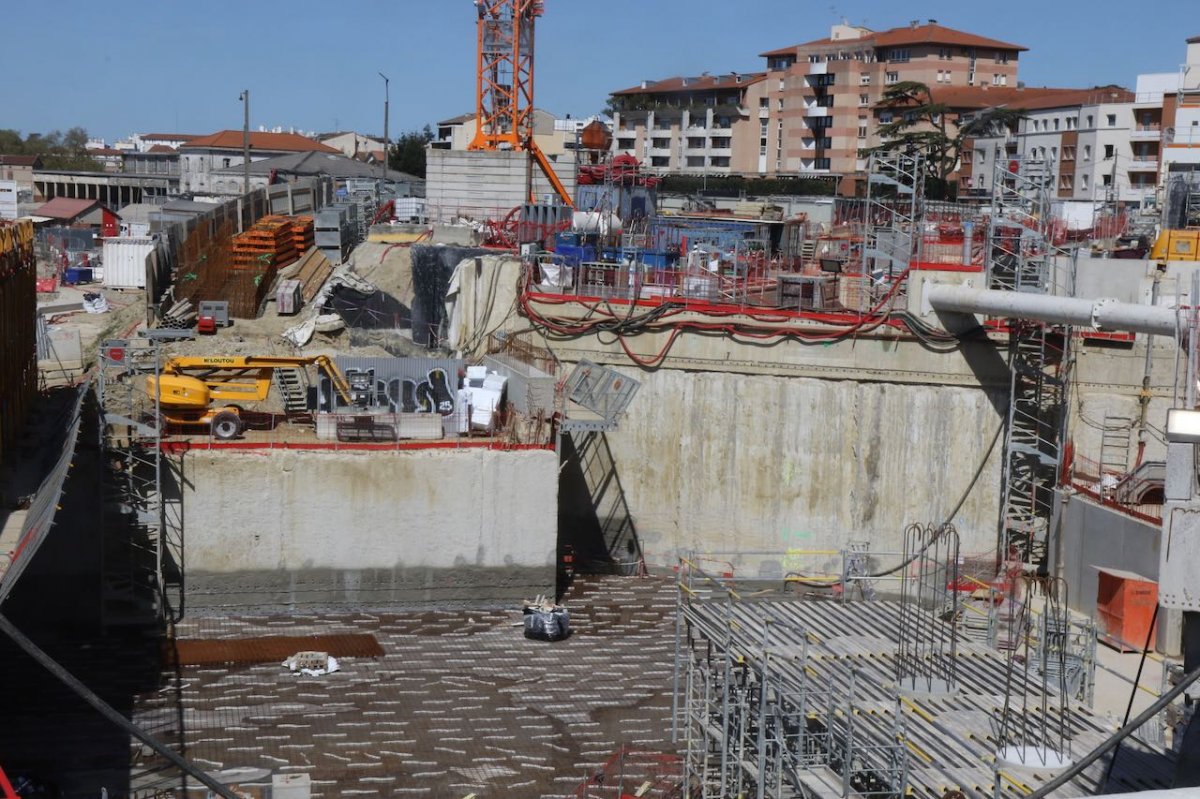
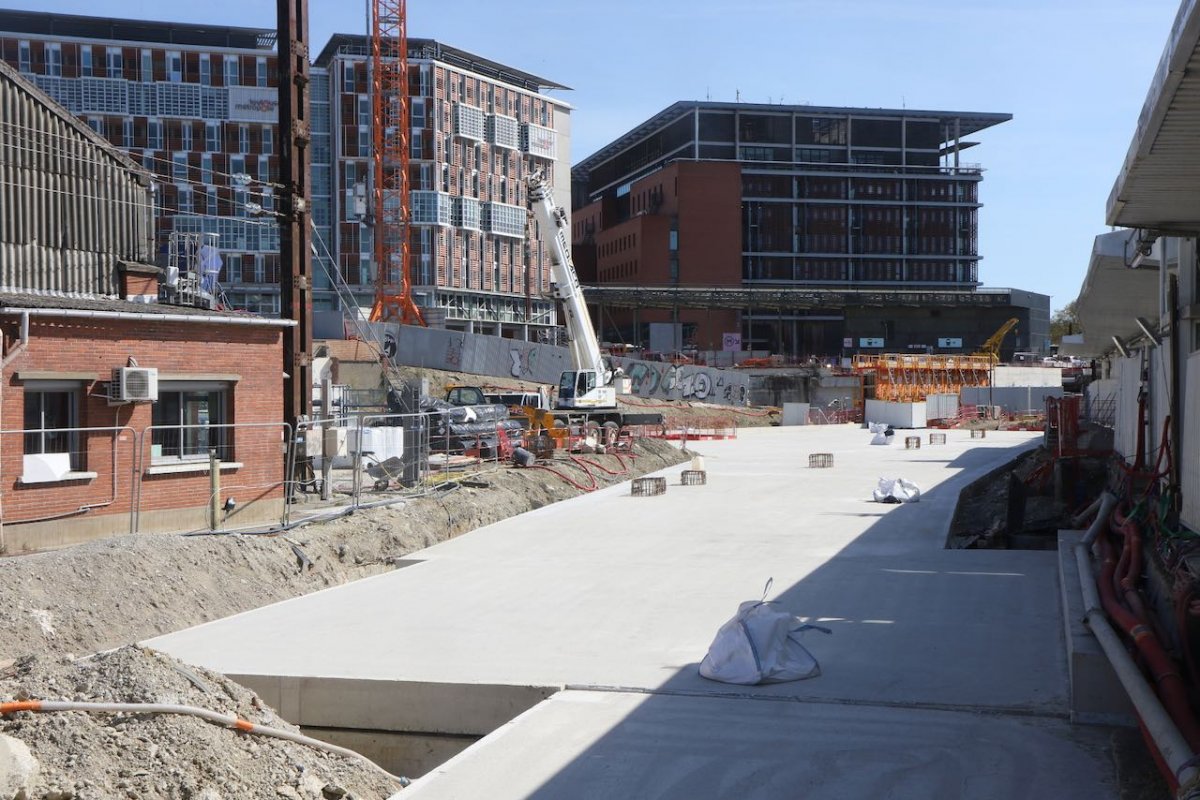
At Matabiau extensive work is underway on the site of the former locomotive depot to provide the new connecting Line C station. Top right shows the site of the former depot building, the traverser having been located to the right of the blue skip. Below left is the excavation for the connection between the mainline and metro stations, and right the former entrance to the depot where the overhead inspection point was located at the south end of the station, a concrete slab covers one of the connecting corridors. Photos: Georges Turpin.
Additions to FRS Photographic Archive during April 2026
To Photographic section
- A new Gregory Marchant gallery Folder 1
- Articles about PLM Diesel-Electric Locomotives and Ouest Serie 3500 “Boer” to Folder 4
- Article about Paris Exposition 1937 to Folder 7
- A “France Trains” Bulletin in respect of detailing CIWL carriages to the “Models” section in Folder 1
Additions to the FRS public folder during April 2026
- A small number of additional timetables have been added to the summary document in the Public Folder
© Peter Lovell & Chris Bushell. The French Railways Society 2026. With thanks to Georges Turpin, Christophe Masse, Didier Delattre, Erwan Quintin, Pierre Julien, John Bamforth, José Banaudo and Roger Allen.
